

 By
By For patients, the use of a telehealth app developmentis straightforward: open the app, schedule a time, and participate in a video call. Behind that experience lies a much more complicated system of scheduling, secure video, e-prescribing, payments, EHR data exchange, and compliance controls that need to function together.
This telemedicine app development guide covers the essential elements, stages of development, security considerations, and cost factors for building a telemedicine solution that can grow and succeed. McKinsey research indicates that the use of telehealth has settled into the 38X pre-pandemic level, confirming that the future of medicine is now virtual.
For companies that are considering building a healthcare platform, they can check out custom healthcare app development services and determine the minimum viable product (MVP), budget, and technical roadmap for the long term.
Why Build a Virtual Healthcare Telehealth App Development in 2026?
The transition from in-person to virtual health care is no longer just a pandemic phenomenon, but has become a new and growing health care channel. According to Precedence Research, the global telemedicine market is expected to grow at a compound annual growth rate of 17.55 percent from 188.93 billion dollars in 2026 to 806.89 billion dollars by 2035.
A virtual healthcare app enables providers to reach a wider patient base, streamline their clinical practice scheduling, and proactively manage their patient outcomes.
For each specialty, there will be a different software architecture and clinical workflow. Behavioral health is currently the most obvious product opportunity, making up 67% of all telehealth visit volume.
However, there are a number of other niche sectors that offer enormous potential for digital transformation:
- Telepsychiatry: Mental health sessions can be arranged and held remotely, which helps overcome the shortage of psychiatric specialists.
- Tele-ICU: Bedside cameras, electronic medical records (EMRs) and real-time monitors enable critical care physicians to monitor patient care from a remote location.
- Telerehabilitation: Physical, occupational, or speech therapy is provided to a patient in his home, under the supervision of a therapist, which reduces the risk of hospital readmission.
- Teleoncology: Advanced systems facilitate seamless record-sharing, imaging review, and collaborative work for the diagnosis and treatment planning for cancer.
- Teledermatology: The digital platform enables specialists to diagnose skin conditions based on a high-resolution image and a dermoscope that’s built into it.
- Teleophthalmology: Remote eye exams involve fundus cameras and optical coherence tomography (OCT), which capture and analyze vast amounts of imaging data.
Types of Telemedicine / Telehealth App Development
There are four general types of telehealth app development platforms in healthcare organizations:
- Live Video Consultation: This model allows real-time interactions between doctors and patients. Teladoc employs such a format for urgent care and general practice.
- Store-and-Forward (Asynchronous): Patients send secure medical data, images, or test results via the app. This data is then reviewed by doctors, and a treatment plan is sent. This is a format that is extensively utilized in dermatology and radiology.
- Remote Patient Monitoring (RPM): Integrate wearable devices such as Apple Watches and Continuous Glucose Monitors (CGM) with your platform through HealthKit and Google Fit APIs. For instance, a remote patient monitoring app can enable cardiology practices to safely track arrhythmias outside the hospital setting.
- Diagnostic and Triage Tools: These platforms help to direct patients to the appropriate level of care based on a symptom checker, imaging analysis, or another mechanism before they even talk to a physician. They identify the critical issues that need to be addressed immediately and alert the attending physician to possible diagnoses.
What Telehealth App Development Features Should You Include?
The American Medical Association’s Physician Practice Benchmark Survey found that 71.4% of U.S. physicians reported using telehealth weekly in 2024, compared with 25.1% in 2018. This means that the telehealth platform must facilitate more than just video consultations.
Telehealth app development features should be compatible with the clinicians, their services, and the patient’s needs. For example, a dermatology platform may depend heavily on image uploads and store-and-forward consultations, while a chronic-care platform may need remote monitoring, automated alerts, and continuous patient data collection.
Patient Features
Patients demand convenience and transparency. Your website or platform should be user-friendly from the login screen.
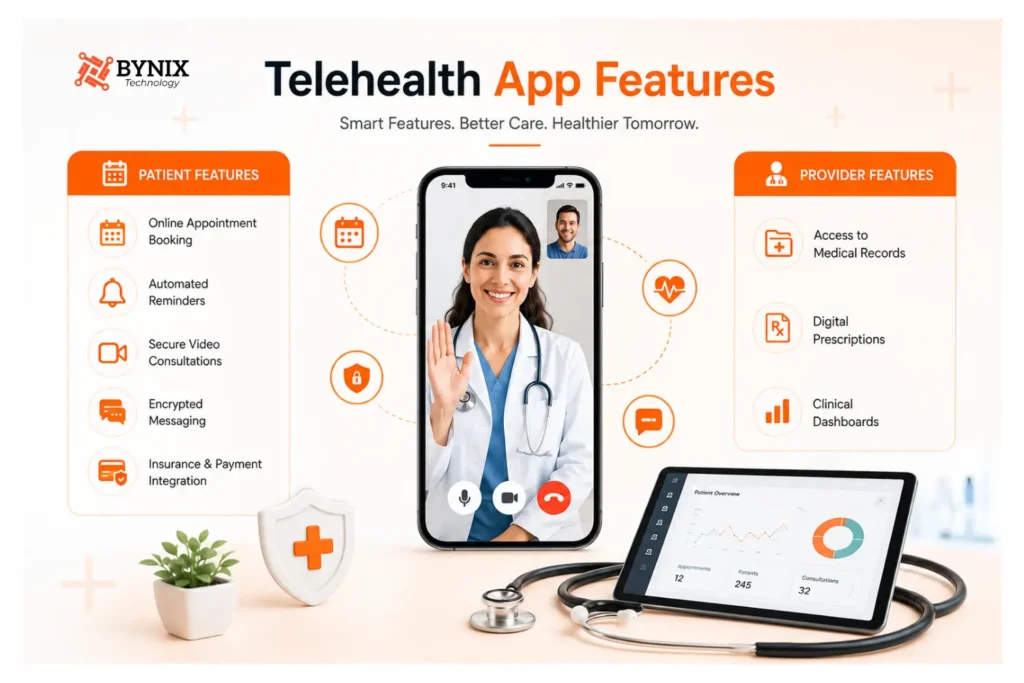
- Online Doctor Appointment Booking: Patients should have the ability to book appointments themselves, and the calendar should be linked to the real-time availability of the clinicians to avoid being double-booked.
- Automated Reminders: Automated Reminders via push notifications, emails, or SMS messages significantly reduce no-show rates and ensure timely follow-up appointments.
- Secure Video Consultations: High-definition video streaming makes a remote visit seem personal and professional.
- Encrypted Messaging: A secure text-based platform enables patients to ask quick questions, get updates, and follow post-visit guidelines safely.
- Insurance and Payment Integration: Securely manage credit cards, mobile wallets, and bank transfers. Real-time insurance eligibility verifications ensure patients are aware of their insurance coverage prior to the visit.
Provider Features
Clinicians will abandon software that slows down their workflow. Your provider-facing interface must prioritize speed and clinical accuracy.
- Access to Medical Records: Physicians must have access to patient medical records in real-time to make informed decisions with all the clinical context.
- Digital Prescriptions: Reusable templates and e-prescription integrations enable doctors to directly send prescriptions to the patient’s local pharmacy.
- Clinical Dashboards: Dashboards that track patient trends, patient outcomes, and daily schedules provide actionable insights for clinics to work much more efficiently.
What Are the Steps in the Healthcare / Telehealth App Development Process?
Creating a medical platform is not the same as creating a typical consumer application. There are stringent clinical requirements, interoperability standards, and privacy laws to navigate. A structured healthcare telehealth app development process reduces the risk and guarantees you bring a safe and working product to life.
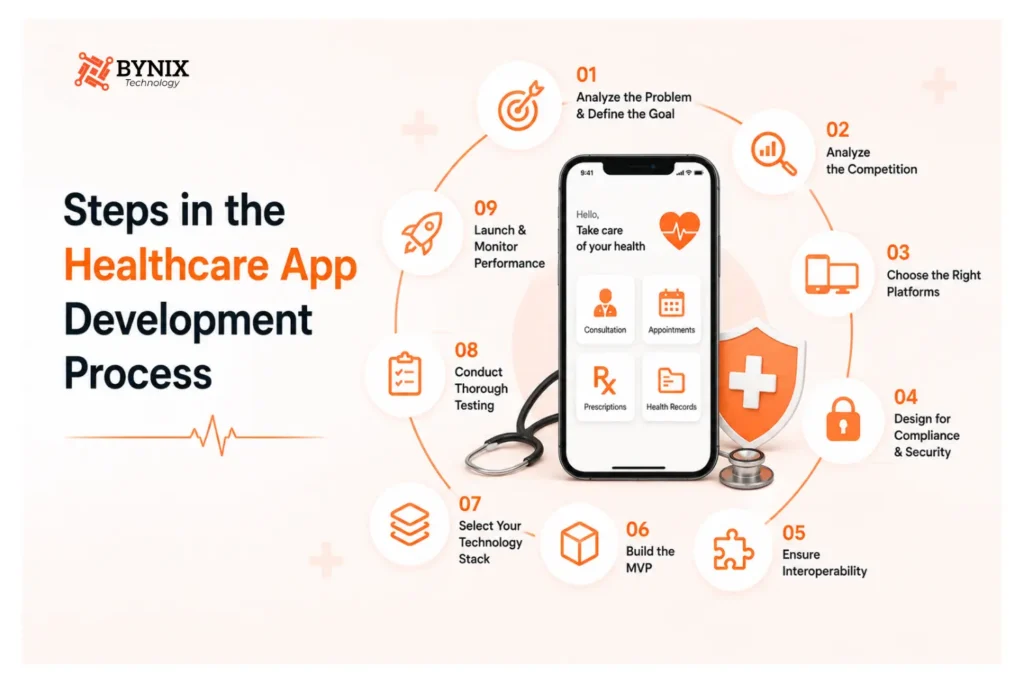
Step 1: Analyze the Problem and Define the Goal
- Establish a clear, specific goal instead of trying to build an app that does everything.
- Identify exactly who will use the app to accomplish one specific task.
- Decide whether you are creating a symptom tracking tool for patients, a provider to run records, or an administrative tool to handle billing.
Step 2: Analyze the Competition
- Identify competitor applications and determine their unique selling points.
- Develop a thorough competitor feature matrix that outlines how your product will be different.
- Identify standard omissions you can address, for example, the ability to sync with fitness apps such as Google Fit and HealthKit, or provide better telemedicine alternatives.
Step 3: Choose the Right Platforms
- Select the optimal platforms based on your target audience.
- Younger people tend to prefer mobile apps and voice-activated assistants, while elderly patients may prefer websites and tablets.
Step 4: Design for Compliance and Security
- Reduce the cost of redesigns and save money by incorporating compliance into the original design.
- Ensure that from the beginning all data is encrypted and that access controls and explicit user consent are in place.
- Create a MoSCoW prioritized list of features. (Must Have, Should Have, Could Have, Won’t Have).
- Design the system to comply with particular regional regulations like HIPAA in the United States or GDPR in Europe.
Step 5: Ensure Interoperability
- Define your application to integrate effortlessly with current systems in hospitals.
- Use the health care standards (mostly FHIR and HL7) to map the data in your app with the data in the health care provider’s Electronic Health Record.
- Safeguard this data in transit between systems for smooth and easy compliance review.
Step 6: Build the Minimum Viable Product (MVP)
- Create a prototype version of your application with just the essential features to address the problem.
- Get critical feedback from real users, but without risking big investments up-front with the MVP.
- Leverage this early data to enhance the product and improve patient care outcomes.
Step 7: Select Your Technology Stack
- Choose trusted infrastructure vendors that meet strict healthcare compliance mandates.
- Video APIs: Select a video vendor that has a Business Associate Agreement (BAA) for HIPAA. Twilio (HIPAA-eligible), Vonage, and Daily.co provide proven and secure video infrastructure.
- Cloud Hosting: Choose cloud infrastructure that has healthcare compliance certifications, like AWS Healthcare compliance or Microsoft Azure for Healthcare.
- Frontend & Backend: React Native or Flutter are ideal for cross-platform mobile applications. In the backend, one can use Node.js or Python (Django), both of which offer a secure and scalable architecture.
Step 8: Conduct Thorough Testing
- Conduct functional testing to make sure that features are functioning correctly on different devices and operating systems.
- Find susceptibilities or vulnerabilities in the system that could compromise patient information.
- Run usability tests with real health care providers and patients to make sure that the interface is user-friendly.
- Set up Continuous Integration and Continuous Deployment (CI/CD) pipelines to automate testing processes.
Step 9: Launch and Monitor Performance
- Try out a soft version with a select group of users to get feedback and make final edits before the general deployment.
- Use App Store Optimization (ASO) strategies to improve app discoverability (including keywords + engaging app description).
- Track key indicators such as user engagement and user retention to identify any quick wins.
- Fix any errors, improve functionality, and keep up to date with security protocols.
How Much Does Telemedicine / Telehealth App Development Cost?
The total financial investment is highly dependent on the quantity of features, platforms, and the level of third-party integration. This telemedicine app development guide will help you build your product to bring you steady income.
Understanding Telehealth App Development Costs
Production platforms vary in price from $75,000 up to $250,000 or higher, depending on the project you want to execute.
If you want to learn more about mobile product budgeting in general, check out our comprehensive guide to building custom mobile apps that scale successfully.
- Basic Application ($75,000 to $120,000): This telemedicine app development budget is for the basic features that are necessary to get a product up and running. It features appointment scheduling, video consultations, encrypted messaging, e-prescriptions, etc.
- Custom Enterprise Application ($150,000 to $250,000+): This is required for workflows to fit with the intricate workings of hospitals. It includes features like advanced telemedicine app development integration, AI-aided diagnostics, remote patient monitoring, and enterprise-level scalability.
How Long Does It Take to Develop a Telehealth App With telehealth app development Company?
The typical timeframe for developing a secure healthcare app is 4 to 10 months, depending on the project’s scope and size.
- Discovery and Requirements (3–4 weeks): Identifying the clinical use case, user journeys, server load, and compliance requirements prior to writing the code.
- UX/UI Design (3–6 weeks): Development of wireframes, user flow testing, and designing user-friendly and high-contrast interfaces for patients and doctors.
- Development and Integrations (3–6 months): Creating the back-end infrastructure, mobile interfaces, and connecting it with video, payments, and electronic health record APIs.
- QA and Security Testing (3–4 weeks): Testing for penetration, load testing, and making sure all the video and messaging features work well across different network conditions.
- Pilot and Launch (2–4 weeks): Rolling out the telemedicine app development software to a limited beta group or to a single clinic to test workflows and get feedback from the clinic prior to the public launch.
What Security and Compliance Requirements Does a Telehealth App Need?
If your team does an inadequate job of executing the software, you have an enormous legal liability with the protected health information (PHI) in your hands. The database structure must be designed to accommodate certain regional laws.
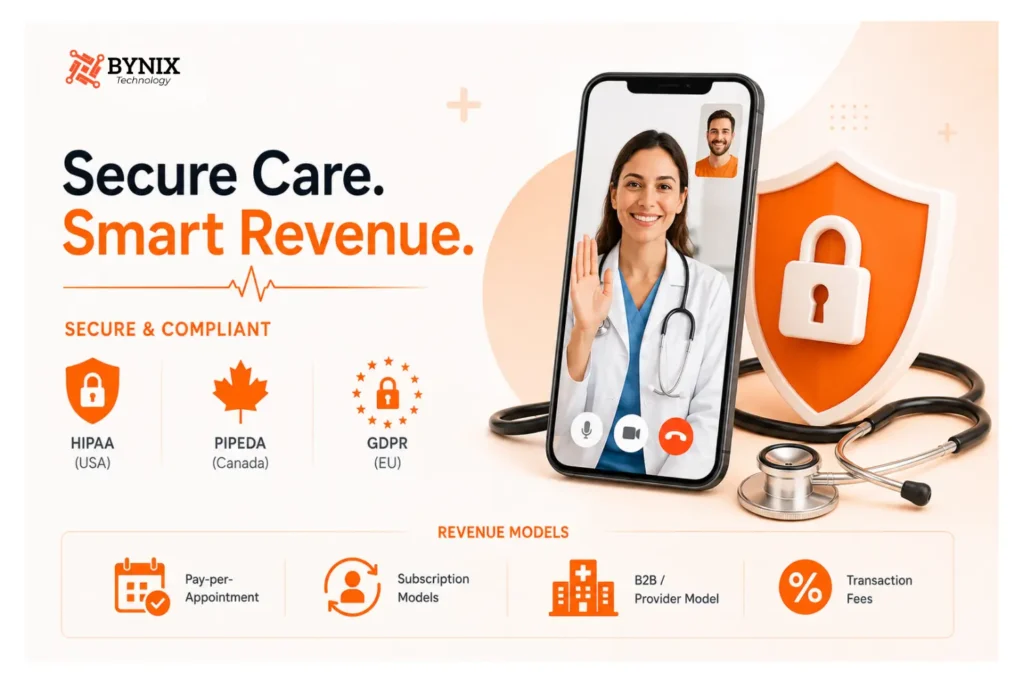
United States: HIPAA Compliance
HIPAA requires that applications that handle PHI have certain technical, physical, and administrative security measures.
The key technical requirements for telemedicine apps are:
- All PHI is encrypted end-to-end, both at rest and in transit, with a minimum of AES-256.
- Unique user authentication with immutable audit logging.
- Auto-expiring user sessions when the user is away from the app.
- Business Associate Agreements (BAAs) with all third-party services providing access to PHI, such as cloud, video platform, and analytics services.
Keep in mind that standard consumer video communication apps such as Zoom and Google Meet are not HIPAA compliant by default. They are not legal to use without a signed BAA and enterprise configuration changes.
Canada: PIPEDA and Provincial Laws
At the federal level in Canada, patient information is regulated by the Personal Information Protection and Electronic Documents Act (PIPEDA). PIPEDA calls for explicit and informed consent to collect data. It gives patients an access right and the opportunity to rectify their personal data. It is also critical to have well-defined data retention and deletion policies.
In addition, the provincial laws regarding health privacy, such as PHIPA in Ontario or HIA in Alberta, impose additional requirements. If your target market is a specific Canadian province, you need to consider these local laws when designing your database.
European Union: GDPR and MDR
Under the GDPR, health data is a “special category” of personal data. This classification needs to be accompanied by explicit patient consent, strict data minimization, purpose limitation, and absolute right to erasure (right to be forgotten).
Moreover, if your European app has diagnostic features, such as an AI symptom checker, the software itself may be considered a Class I or Class IIa medical device under the EU Medical Device Regulation (MDR). This classification has strict CE marking obligations. Before introducing any diagnostic device into the EU, it is critical to collaborate closely with a healthcare regulatory attorney.
How Can a Telehealth App Generate Revenue?
A good clinical feature set can only produce ROI if your business model fits the way patients like to pay for care. Custom development becomes the superior choice when your product requires proprietary clinical workflows, specialized patient journeys, or a dedicated remote patient monitoring app with deep hardware integrations.
- Pay-per-appointment: One-time, fixed payment per appointment video consultation or asynchronous messaging session. This simple, transactional model is highly effective for on-demand urgent care, for pediatric after-hours care, or for second opinion specialties.
- Subscription models: With this option, patients are charged a monthly or annual subscription fee for ongoing use of the telehealth platform. It is used for chronic condition management, weight loss programs and mental health therapy. Subscriptions are a very predictable, long-term revenue stream for your business.
- B2B/Provider model: You license the platform as a Software-as-a-Service (SaaS) to a hospital, private clinic, or insurance network. The hospitals pay you to use the technology with their present patient panels.
- Transaction fees: The platform serves as a marketplace linking independent practitioners and patients. The business gets a small percentage of all consultations conducted through the system.
Conclusion
Telehealth app development in 2026 is not just about creating a video consultation functionality and placing it on a website. Product teams need to plan for the clinical workflows very carefully, have patient access as a top priority, interoperate with the EHR as much as possible, and implement security from the ground up. Rushing the regulatory planning phase often results in fragmented software that frustrates busy clinicians, alienates patients, and risks severe compliance penalties.
Immediate and measurable ROI for health care organizations comes from features such as AI-powered symptom triage, secure e-prescribing, automated patient reminders, and remote wearable monitoring.
Founders need to be paying attention to ways to decrease no-show rates, ensure convenient, secure messaging, and simplify prescription workflows to successfully navigate the crowded digital health landscape.
Building a health care platform? Explore our healthcare app development solutions at Bynix Technology, and let our engineering experts help you map out your technical roadmap today.
Frequently Asked Questions
How much does it cost to build a telehealth platform?
The costs start at $75,000 to $120,000 for a simple platform that includes basic video and scheduling tools. For enterprise-level architecture, deep EHR integrations, AI symptom triage, and connected wearable device monitoring, development is typically between $150,000 and $250,000, and up.
How long does it take to develop a custom healthcare app?
Typically, most custom telehealth applications take 4 to 10 months to develop from concept to launch. The strategic planning and UI design process generally takes 4-6 weeks. For backend development and complicated API integration, it takes 3 to 6 months. Finally, there’s security testing and test launches, which take 4 to 8 more weeks.
Can a telemedicine app integrate with our existing EHR system?
Yes, custom telemedicine applications can be securely integrated with major EHR systems, such as Epic and Cerner. Healthcare data protocols like HL7 APIs and FHIR APIs enable developers to integrate patient data, lab findings, and billing codes smoothly from your mobile app to the hospital database.
What is the difference between custom software and SaaS telehealth platforms?
SaaS-based solutions provide pre-designed capabilities with recurring fees, which makes them an excellent choice for small clinics that want to get up and running quickly. While custom software may come with a higher upfront cost, it provides the organization with full control over the software, access to all the data, and the freedom to customize clinical workflows exactly as required.
What is the difference between synchronous and asynchronous telemedicine?
Synchronous telemedicine is when the patient and doctor are interacting in real time, usually via a secure video or voice call. In Asynchronous Telemedicine (also called store-and-forward), patients can securely send medical records, messages, or images to a provider, who will later review and reply.
4 Comments