

 By
By Developing a medicine delivery app ranges from about $10,000 to $150,000, depending on features, platforms, integrations, and development location. An MVP for medicine delivery in India would cost around 3 lakh to 25 lakh rupees ($5,000 to $15,000). Complex multi-vendor platforms would cost much more.
This guide is about the medicine delivery app development cost across different app types, feature sets, development phases, and business models.
It also talks through the drivers behind the online pharmacy app cost, from prescription uploads and payment flows, inventory handling, pharmacy operations, delivery tracking, and various third-party integrations.
How much does it cost to build a medicine delivery app?
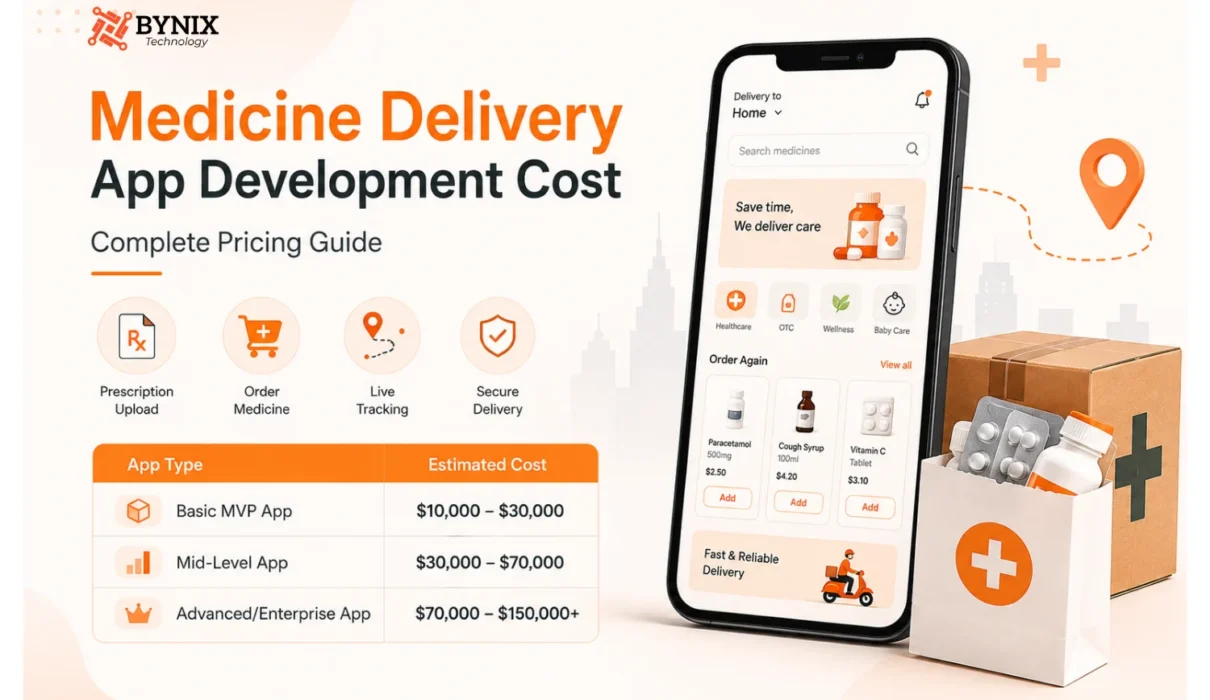
The final medicine delivery application development cost will vary based on the app’s complexity, features, and technical requirements. A practical planning range for a custom product is like this:
| App type | Estimated cost |
| Basic MVP App | $10,000-$30,000 |
| Mid-Level App | $30,000-$70,000 |
| Advanced/Enterprise App | $70,000-$150,000+ |
These are rough development ranges, not fixed market quotes. The final estimate depends on how many platforms you want, user roles involved, integrations needed, the level of design detail, pharmacy workflows, the location, and what compliance requirements are required by local rules.
What does medicine delivery app development cost by feature?
Medicine delivery app features influence the whole development budget. And instead of sticking a single price on each little feature, it’s often smarter to look at the core panels and the key systems that keep the whole platform running. This breakdown should give you a more grounded view of the main cost areas, the ones that actually matter:
| Core Feature Panel | Indicative Cost |
| User Panel | $8,000-$20,000 |
| Pharmacy/Admin Panel | $10,000-$30,000 |
| Delivery Executive Panel | $5,000-$15,000 |
| Compliance & Security | $10,000-$50,000 |
These numbers are rough estimates corresponding to the size of different apps, not figures that need to be summed. Each range shows the expected cost for the development of the app, features, design, back-end, testing, and infrastructure for the app at that level of complexity.
What features should have priority for medicine delivery app?
For an MVP, you should focus on the core elements that really help a smooth customer ordering experience and keep pharmacy operations moving efficiently.
Give priority to the workflows that matter most, the essential ones, like the ones below:
- Medicine search, product information
- Prescription uploads
- Cart and checkout
- Secure payment
- Address management
- Order status
- Pharmacy order processing
- Notifications to customers
- Basic admin
- Order re-ordering and customer repeat purchasing
How much does an online pharmacy app cost based on the business model?
The online pharmacy app cost changes depending on the business model. A marketplace that serves more than one pharmacy needs extra infrastructure, more work than a direct-delivery platform, and telehealth integrations can drive the spending even higher.
A white-label solution is often the cheapest to start, but in return it typically limits how much you can customize and what subscription options you can get.
| Business Model | Cost Range (MVP to Full-Scale) |
| Aggregator / Marketplace Model | $40,000–$120,000+ |
| Inventory-Led / Direct Delivery Model | $25,000–$75,000 |
| Telehealth + Pharmacy Hybrid Model | $80,000–$180,000+ |
| White-Label / Pre-built SaaS Model | $5,000–$15,000 upfront |
Read More: – Telehealth App Development: A Step-by-Step Guide for 2026
What are the main factors affecting the price of creating a pharmacy app?
Pharmacy app development pricing will depend on multiple platform app support, workflow, integration, delivery, security, and compliance requirements.
Number of platforms
Designing, developing, testing, and maintaining apps for Android, iOS app development, Web, Pharmacy dashboards, and delivery applications can be costly and time-intensive. Cross-platform development may prove beneficial and cost-effective; however, native development may be the best choice to suit certain technical needs.
Relatable: Doctor Appointment App Development Cost
Number of User Roles
A system with many different user roles such as customers, pharmacists, pharmacy managers, delivery partners, and administrators will be more complex than a system with only the customer role.
Inventory Complexity
A system with a static catalog will be less costly than a system with a real-time inventory synchronized across all pharmacy locations. Systems with stock conflicts, substitutions, out-of-stock medicines, and partially fulfilled orders require more complexity at the back end.
Delivery model
Scheduled delivery comes with several nuances, such as driver tracking, automated delivery and route assignment, cancellation, and verification of delivery. All of these increase the effort required and make scheduled delivery more complex.
Integrations
The development and recurring expense of third-party integrations of payment gateways, mapping APIs, SMS, push notification, pharmacy software, analytics, identity verification, and healthcare systems will be required.
Security and compliance
With respect to ordering medication, the platform has to manage prescriptions, personal data, payment data, and other sensitive data. Hence, security architecture, access controls, audit logs, encryption, testing, and compliance for different regions should be accounted for in the budget.
How much does each mobile app development stage cost?
An app development budget is easier to manage when divided into stages.
| Development Stage | Typical Cost |
| Discovery & Planning | $3,000-$15,000 |
| UI/UX Design | $5,000-$25,000 |
| Core Development | $15,000-$60,000+ |
| Testing & QA | $5,000-$15,000 |
| Deployment & Launch | $2,000-$10,000 |
| Maintenance & Support | 15%-20% of the original development cost annually |
- Discovery & Planning: Establishes the app’s functions and user flow, and breaks down the features, required tech, and development milestones.
- UI/UX Design: Creates wireframes, user flows, prototypes, and designs the UI.
- Core Development: Delivers the primary coding, designs the app’s backend, sets up the app’s database, creates required APIs, and builds the app’s core functionalities.
- Testing & QA: Evaluates the app’s security, checks the performance, and ensures the app’s compatibility and reliability before the software’s launch.
- Deployment & Launch: Sets the app’s production-ready state and configures and hosts the app’s software on the app stores.
- Maintenance & Support: Consists of hosting and providing continuous technical, performance, and support for the app’s software.
Account for costs beyond development. Pharmacy onboarding, delivery, support, marketing, compliance, and maintenance cost a considerable amount and will provide a more accurate projection of the total launch budget.
Glace Over Here: – Top 7 Signs Your Business Is Ready for a Custom Mobile App
What recent statistics matter when planning a pharmacy app?
Founders developing an app should evaluate market statistics and funding statistics. Ken Research reports India’s projected e-pharmacy market size of $3.5 billion in 2025 and projected CAGR of 16.18% with over 140 million orders in 2025. Repeat purchases and customer retention are critical for app success, as indicated by the projected high volume of orders.
Security is also important. The average cost of an IBM data breach in 2025 across the globe is $4.44 million, and for the healthcare industry, it is $7.42 million. In India, the cost for 2025 is INR 220 million, as opposed to INR 195 million in 2024.
These figures are not exactly direct development expenses, but they show why cutting down on security investment can put a pharmacy platform at serious financial and operational risks.
Regulatory rules can influence the whole app design. The exact requirements may be different across each country, so prescription handling, pharmacist licensing, and compliance should be double-checked before any development actually starts.
How can you reduce the cost to build a medicine delivery app?
You can reduce the cost to build a medicine delivery app by releasing an MVP (Minimum Viable Product) with the most essential features first, instead of trying to develop a full-scale platform from the very beginning.
Keep the first version tight around the core tasks, like:
- Customer registration and medicine search,
- Prescription upload,
- Verification,
- Cart building and checkout,
- Secure payment handling,
- Basic order tracking,
- Pharmacy and admin controls,
- Reorder functionality.
Avoid being too ambitious early on, like avoiding complex loyalty systems, AI recommendations, advanced route optimization, or even multi-country compliance stuff, before the main business flow is actually validated.
Relatable: How to Build a Doctor Appointment App Like Doctolib: Features, Cost & Process
How much should you expect to spend on your first model?
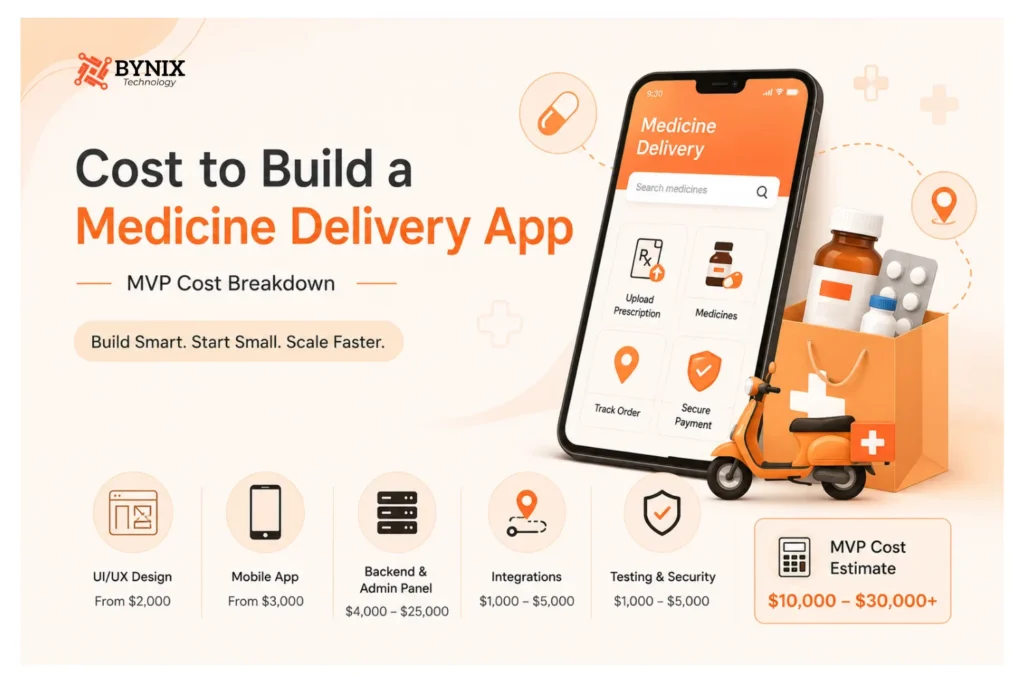
Your initial medicine delivery app development cost will depend on the complexity and size of your first release. A practical estimate of an MVP can be divided into the following core areas:
- Structure and user flow, designed UI and UX, starts around $2,000 for wireframes, user journeys, and key app screens.
- Android app or iOS app development for customer use starts around $3,000, while the Backend and Admin Panel for users, orders, and catalogs for a basic pharmacy management system comes in at $4,000 to $25,000.
- Maps and payment systems, along with 3rd-party service integrations, come in around $1,000 to $5,000.
- Cost for bug detection, performance checks, and security is $1,000 to $5,000.
This offers a starting point for an MVP cost estimate.
What are some aspects of developing a medicine delivery app that you should be aware of?
You should determine the product scope and development effort before the development phase. Consider the business model, the target market, desired MVP features, pharmacy workflow, delivery flow, and compliance first. Each will help you establish the scope and effort required for development.
Each of the following must be addressed to a certain extent:
- The target market – Before starting development, you will need to understand the location of your customers and their ordering behaviors.
- The business model – Consider your pharmacy’s operations and your growth strategies, then decide between a direct delivery model, a marketplace model, or a hybrid model.
- The MVP scope – Understand what the MVP should include and what you can develop later, if you wish.
- Pharmacy operations – Consider the pharmacy workflows for prescription orders, inventory, and the fulfillment of verified orders.
- Delivery workflow – Consider how orders will be assigned and tracked, confirmed, canceled, and delivered.
- Compliance – Consider the healthcare, privacy, prescription, and payment laws in your targeted region.
- Required integrations – Consider which payment systems you will require, map users to services, create APIs, determine the notification systems, and evaluate other services you will use.
Conclusion
Creating a successful pharmacy delivery application requires good product strategy and understanding of customer and pharmacy pain points. Begin with essential features and test demand before evolving the product to meet user needs.
If you want to create an on-demand medicine delivery app, you can start with secure ordering, delivery, payment, prescription management, and handling. A clear product roadmap helps avoid excessive features.
Are you ready to convert your pharmacy application idea into a product ready for the market? Start by defining what you truly need, the proper way to build it, and finally take that first step toward a product customers can trust.
FAQs for Medicine delivery app development cost
1. How much does it cost to develop a medicine delivery app?
Developing a medicine delivery app usually costs around $15,000 to $150,000+ for truly custom work. But if you decide to go with a pre-built or white-label type option, the total price can vary from $5,000 to $20,000.
2. How long does it take to develop a medicine delivery app?
A basic medicine delivery MVP typically takes 3-5 months. A mid-level app may require 5-8 months, while an advanced or enterprise platform can take 8-12+ months, depending on features, integrations, testing, and compliance requirements.
3. What features are essential in a medicine delivery app?
Essential features include searching for medicine, uploading a prescription, product information, cart and checkout, secure payment, address management, order tracking, notifications, processing of orders by the pharmacy, and some basic admin controls. These features enable the creation of a first version of the app with the most important features without introducing too much complexity.
4. What makes an online pharmacy app more expensive to develop?
Addition of multiple user roles, real-time inventory, integrations with pharmacies, tracking of deliveries, complex payment systems, custom security, regional compliance, and supporting Android, iOS, web development services, pharmacy dashboards, and delivery applications greatly increases development time and incurs additional costs.
5. Is it cheaper to make a medicine delivery MVP first?
Yes. It is less expensive to create a medicine delivery MVP first, as it needs development to include customer, pharmacy, payment, scripts, and delivery workflow functionalities. Once the product is validated and the customer demand is known, advanced functionalities can be built in phases rather than spending money on complex features that may never be used.
6. Should I go for a custom or a white label pharmacy app?
A white label solution can have a quick launch and is cost-efficient, but a high degree of customizability cannot be guaranteed. A high degree of customizability is guaranteed through a custom-built solution, as desired features can be developed with a lot of control over integrations, security, user experience, as well as the scalability of the product.
2 Comments