

 By
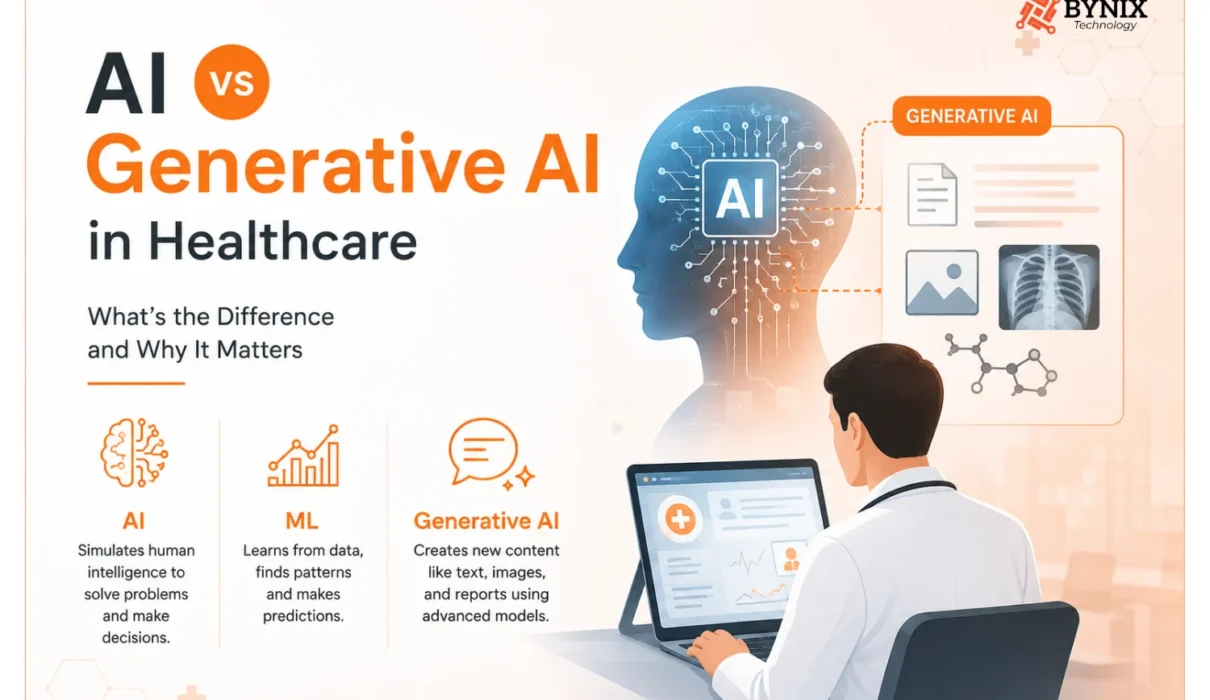
By Clinicians and hospital leaders are grappling with the question of how important new computational tools are in practice and what their advantages are. Clinical leaders must now understand AI vs Generative AI in healthcare, particularly how AI benefits over traditional predictive models and the emerging AI vs Generative AI in healthcare industry. Legacy analytical tools are used to analyze patterns and predict or classify patient outcomes, while generative tools produce new clinical text, synthetic images, ambient discharge summaries, and intricate molecular structures.
The transition between traditional computational logic and generative capabilities is a critical point to be aware of for optimizing clinical care, reducing administrative workloads, and enhancing overall diagnostic accuracy.
Main Concepts: Analyzing Terminologies
It’s important to break it down into the fundamental components of modern health technology to understand how these systems work within a hectic hospital network. In 2024, 71% of U.S. hospitals reported using predictive AI integrated with their electronic health records (EHRs), up from 66% in 2023.
- Artificial Intelligence (AI): A very general term for all the computers, algorithms, logic engines, and custom software that are trained to perform tasks that in the past required human thinking and intelligence.
- Machine Learning (ML): A specialized subfield of software intelligence that involves statistical algorithms that attempt to discover patterns in large amounts of existing data, and then predict patterns without any explicit, step-by-step human programming.
- Generative AI: A superior form of AI that uses deep neural networks, including Large Language Models (LLMs) and diffusion architectures, to generate novel and entirely original pieces of text, images, synthetic biological data, or clinical reports.
Traditional AI vs. Generative AI Head-to-Head: Applications in Healthcare
| Feature / Metric | Traditional AI & Machine Learning | Generative AI |
| Primary Function | Classification, pattern recognition, and risk prediction. | Content generation, natural language synthesis, and original data creation. |
| Input & Output | Inputs structured/unstructured data; outputs numerical scores, probabilities, or category tags. | Inputs natural prompts or multimodal data; outputs clinical notes, text, synthetic images, or molecular designs. |
| Primary Focus | “What is happening?” or “What will happen?” | “How can I summarize, draft, or design a solution for this?” |
| Key Clinical Role | Risk stratification, anomaly detection in radiology, and patient deterioration alerts. | Draft-writing medical discharge summaries, ambient clinical documentation, and designing new candidate drugs. |
| Primary Strength | Highly consistent, rule-bound, deterministic outputs with low hallucination risk. | Flexible, highly fluent in human language, and capable of solving complex multi-step creative tasks. |
| Risk Factors | Data bias, algorithmic overfitting, and misclassification. | Model hallucinations, confident false statements, and data privacy leaks during token handling. |
Let’s Talk About Your AI Roadmap.
Whether you’re exploring AI-assisted diagnostics or generative AI tools for patient care, we’ll help you figure out what’s actually worth building.
>>>>>>>[Contact Us →]
Traditional AI and Machine Learning: Healthcare Use Cases
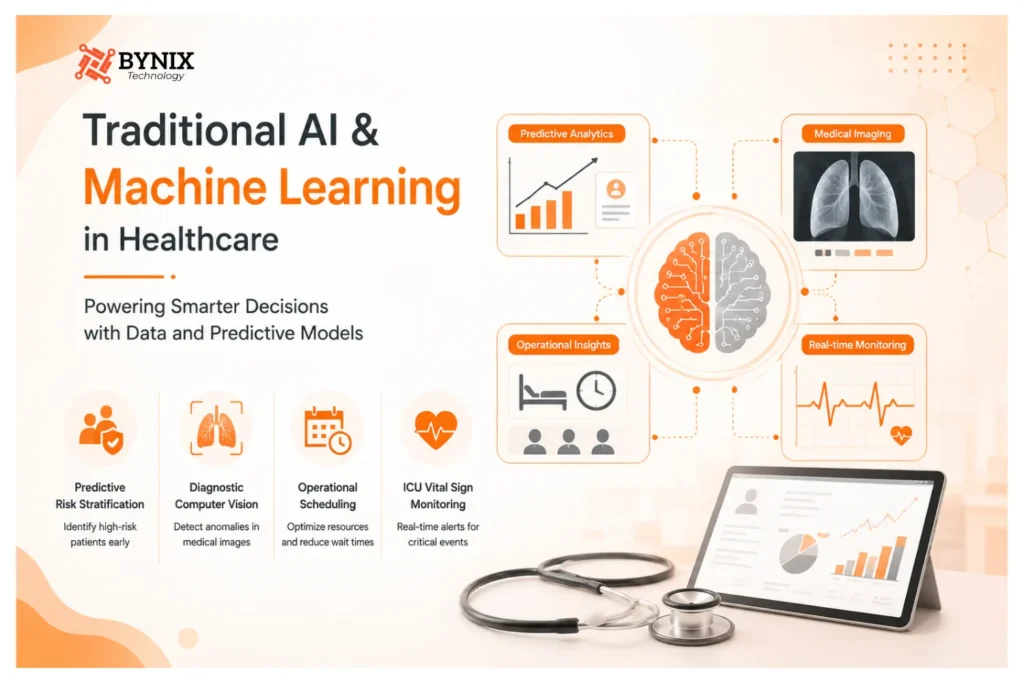
Machine learning in healthcare has depended on large historical databases of electronic health records (EHR), lab results, imaging data, and more, which are used to build statistical models. These tools are great when they’re provided with clean data and with clear single-purpose goals.
Key analytical use cases:
- Predictive Patient Risk Stratification: Using past health data to determine a patient’s risk of being readmitted to the hospital within 30 days or spot mild physiological changes that may indicate early sepsis.
- Diagnostic Computer Vision: Processing thousands of images from a mammogram, chest CT scan, or another non-invasive scan to identify suspicious lesions or micro-calcifications for a radiologist to review.
- Operational Scheduling Models: Prediction of bed turnover in the ED, surge and appointment no-shows in clinics, in order to optimize staffing resources during the day.
- ICU vital sign telemetry: Continuously analyzes real-time heart rate and blood pressure streams and notifies nursing staff of upcoming cardiac events.
Traditional machine learning systems excel when working with numerical data or with structured data: Is this picture scan normal or abnormal? Is this patient likely to need intensive care within 12 hours?
Generative AI Usage in Medical Diagnoses and Production of Medical Content
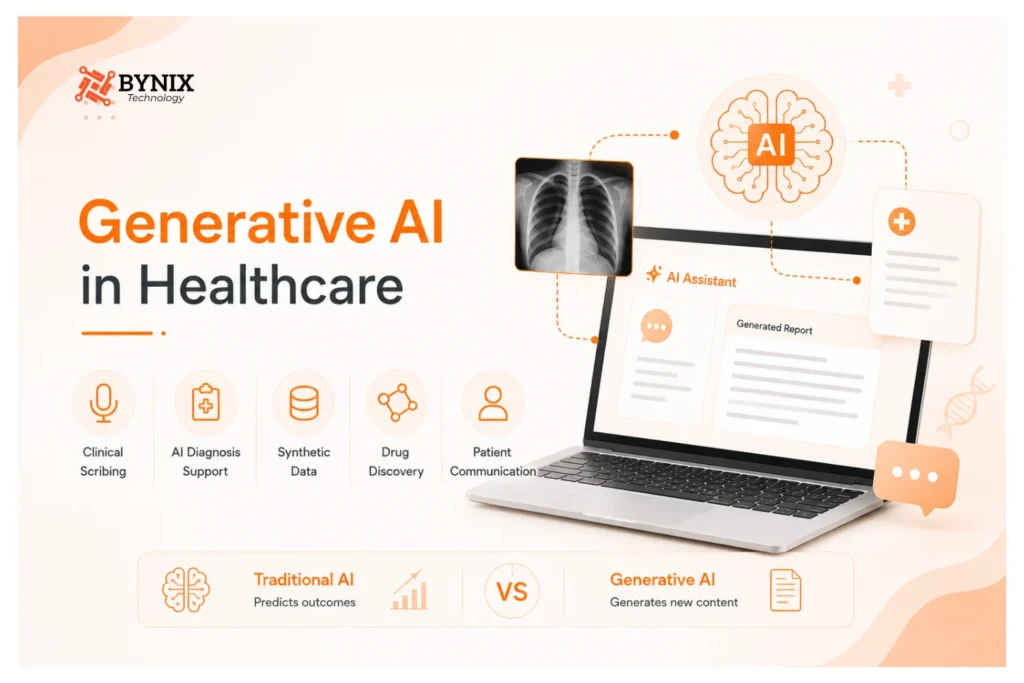
Generative platforms merge flexible, natural-language interactions with today’s software. Generative models can go beyond tagging and sorting current hospital records; they edit and generate medical stories from unstructured clinical notes and compose full medical documents in seconds, supporting generative AI medical diagnosis.
Dominant Generative Capabilities
- Ambient Clinical Scribing: Converting free-text doctor-patient interactions to structured SOAP notes in the EHR.
- Generative AI Medical Diagnosis Support: Summarize information from complex, multi-page medical records, previous tests and evaluations, and medical consultations from specialists, and provide a doctor with a concise diagnosis.
- Synthetic Medical Data Generation: Generation of realistic and privacy-compliant synthetic patient datasets to support research teams in developing clinical algorithms without violating patient privacy.
- Totally New Target Drug Discovery: Design of novel drug candidates addressing specific biological proteins, which would shorten the initial research in a drastic manner.
- Patient-Facing Communication: Developing brief, easy-to-read, patient-empathic medical results communication letters for a range of reading comprehension levels.
Read More: – How to Build a Doctor Appointment App Like Doctolib: Features, Cost & Process
Design Disparities: Discriminative Engine vs Generative Engine Logic
Both paradigms have certain differences in their mathematical framework behind the computational aspects: Discriminative Modeling vs. Generative Modeling.
- Conditional Probability Models (Traditional AI): These models take into account the conditional probability $P(Y\vert{}X)$, which is the probability that the input X belongs to the class Y. The model learns the decision boundaries between the data sets. In the case of the X-ray chest image, for instance, say that you have an X-ray image of the chest, and the discriminative model examines pixels to yield a binary prediction of whether or not there is Pneumonia Present in the image.
- Generative Models (Generative AI): These architectures compute the joint probability P(X, Y) (learning how features and labels are co-occurring over the full training distribution). The model learns the rules of structure of a text or an image, and then generates new instances Y’ of these rules that are similar to real data. Instead of just generating a label, it produces a full, detailed radiology report, in natural language, that describes the lung fields.
In-Depth Clinical Exploration: 5 Authentic Situations
When these differences are applied in the real world at the hospital bedside, you can visualize the 5 common issues each technology has:
1. Emergency Department Triage:
- Traditional Approach: Assesses vital signs (HR, temperature, BP) and gives a score of 1 through 5 on an Emergency Severity Index.
- Generative Approach: Summarizes to the attending Emergency Physician the chief complaint(s), previous medical history, and the nurse’s verbal notes.
2. Oncology Treatment Planning:
- Traditional Approach: Calculates predictive algorithms using survival tables to get prognosis scores for 5 years after therapy, for different chemotherapy treatments.
- Maintenance Approach: Prepared individualized, easy-to-understand treatment plans with the patient and family members that include treatment and possible side effects.
3. Radiology Workflow:
- Traditional Approach: Scans the lung slices on the CT and automatically outlines the red boxes that indicate possible pulmonary nodules.
- Structural Report: Generative Approach, writes a whole structural report of the radiology, including pre-comparative studies from 3 years ago in the report.
4. Clinical Trial Recruitment:
- Traditional Approach: Asks questions of database data with structured fields, like age, diagnosis code, lab ranges, and returns a numeric list of matching patient ID numbers.
- Generative Approach: Confirms complex, qualitative inclusion criteria on unstructured physician progress notes and creates personalized outreach letters such as: “Patient has reported that prior immunotherapy caused him to experience severe fatigue.
5. Medical Coding & Revenue Cycle Management:
- Traditional Approach: Flags billing codes that have been found to be likely denied claims in the past.
- Generative Approach: Reads the entire inpatient chart to automatically create formal pre-authorization letters for insurance claims and appeal letters for denied claims.
Regulatory, Governance, and Safety Paradigm
Traditional systems and generative systems are drastically different, so agencies evaluate differently and have different governance:
- The Software as a Medical Device (SaMD) Rules for Traditional Models: These are typically evaluated as deterministic diagnostics. To guarantee that the algorithm does not produce many false positive calls and yet does capture the anomalies, regulators check accuracy metrics such as sensitivity, specificity, and ROC Curves (Receiver Operating Characteristic).
- Risk Frameworks for Generative AI Medical Diagnosis Systems: Regulating Generative systems is more complex, as there are non-deterministic outputs from the model, which can present a different response to a given prompt each time. Governance is concerned with output alignment, guarding against hallucinations, preventing prompt injection attacks, and adhering to HIPAA privacy protocols in patient clinical note processing.
Building AI or Generative AI Into a Clinical Workflow?
From triage scoring models to generative documentation tools, getting the architecture, and the compliance – right is non-negotiable in healthcare. Let’s talk through your use case.
>>[Talk to Our Healthcare AI Team →]<<
Human-in-the-loop Integration: What is your favorite strategy?
Health systems employ separate human oversight workflows to safely deploy AI healthcare use cases without placing patients at clinical risk:
- Validation of predictive alerts: A physician confirms whether a patient has been identified as having a risk of sepsis by traditional machine learning in healthcare and looks at telemetry data and lab values before giving antibiotics. The AI can function as a digital surveillance system.
- Physician as Editor: If the physician uses generative software to write a discharge summary or chart note, then the physician is serving the role of editor. The clinician reads it back and compares facts to patient documentation, adjusts and signs off. The generative AI in the healthcare industry serves as a clinical co-pilot.
Relatable – Telehealth App Development: A Step-by-Step Guide for 2026
The Significance of Healthcare Decision-Makers Getting this Right
By recognizing these structural differences, health systems will avoid wasting software dollars. While the reasons for using a complex, generative platform are valid, the use of a simple, deterministic machine learning model is more cost-effective and poses no unnecessary safety risks on top of cloud compute costs. In contrast, using the older predictive algorithms causes a lot of clinical staff to be bogged down in cumbersome paperwork.
- To combat Physician Burnout: Clinical teams spend almost 2 hours on administrative typing for every hour of direct patient care. One direct solution to this problem is the automatic chart documentation in real time, which is the goal of the generative ambient scribes.
- Optimizing Operational Return on Investment (ROI): The typical AI healthcare applications for numerical tasks, such as billing coding or predictions of bed assignment, continue to be much more cost-effective and easier to deploy and maintain. Computationally intensive generative models are reserved for complex language processing, research synthesis, and clinical notes by healthcare leaders.
- Diagnostic Accuracy Synergy: Generative AI in the healthcare industry provides a big-picture view of the patient’s clinical history on top of the image alert, whereas traditional computer vision only identifies subtle physical anomalies on scans.
Achieving Success: Key Operational Problems and Guardrail Demands
Incorporating these sophisticated tools into hospital systems presents unique operational challenges:
- Data Privacy and Regulatory Compliance: To prevent the leakage of sensitive personal health information (PHI) or its use in training public foundation models, generative platforms must adhere to rigorous enterprise-grade security measures.
- Controlling Model Hallucinations: Generative systems sometimes confidently assert false information. Clinicians need to sign every document generated by an AI, which is a “human-in-the-loop” process that health systems should implement.
- Algorithmic Bias and Fairness: Traditional predictive models may exacerbate the inequalities of treatment in history when their training sets are not demographically diverse. Both technologies require regular audits over different patient populations.
Evolving the Way: Future Path for Modern Health Systems
The future of clinical technology is a blend of the two. AI in healthcare offers the stable, deterministic groundwork that is essential for accurate predictive risk, patient monitoring, and scan analysis. The growing generative AI healthcare sector is redefining the way care teams work with data, cutting down on paperwork, enhancing patient interactions, and opening fresh opportunities for research.
Combining traditional machine learning with specific medical diagnosis support tools based on generative AI can help healthcare organizations alleviate workload stress, streamline processes, and enhance patient outcomes.
Frequently Asked Questions About AI vs Generative AI in Healthcare
1. What’s the core difference?
Traditional AI can predict, diagnose, classify, etc. (e.g., sepsis risk scores); Generative AI can generate and summarize (e.g., clinical notes).
2. Can Generative AI work on its own?
No. All outputs need to be reviewed by clinicians because of non-deterministic responses and risk of hallucination (Human-in-the-Loop).
3. Is it advisable for hospitals to use generative AI for all purposes?
No, because structured data tasks such as bed tracking or telemetry alerts are far more cost-effective, quick, and accurate with traditional AI.
4. How does regulation differ?
Traditional AI uses a set of metrics, or scores (sensitivity/specificity); Generative AI needs to be governed for privacy, token management, and hallucination prevention.