
 By
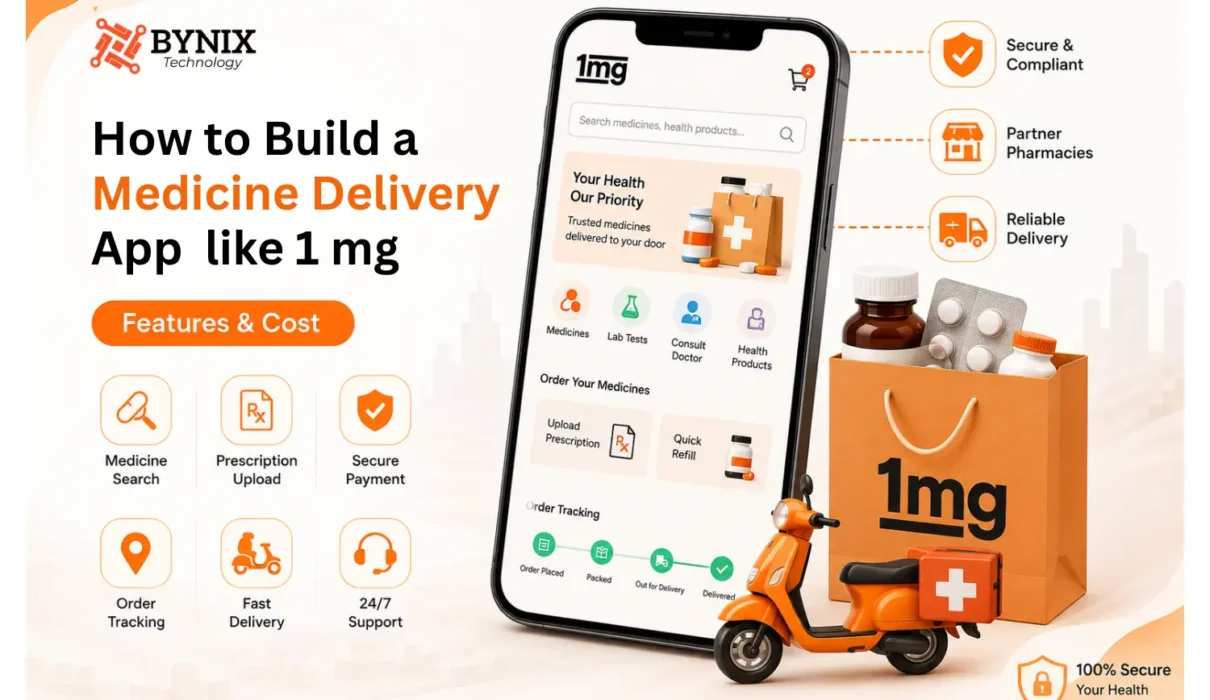
Creating a medicine delivery application is not as simple as putting a medicine catalog and a basic checkout page. Founders must link patients with registered pharmacies, cross-check prescriptions, update local pharmacies’ stock, organize logistics for drivers, and secure patient information in one digital platform. That complexity impacts your software development schedule and your overall medicine delivery app development strategy.
According to industry estimates, Tata 1mg achieved a turnover of around ₹2,390 crore in FY25, underscoring the robust financial sustainability of a successful platform. To create a platform like 1mg, begin by clearly outlining your business model, identifying the initial service requirements, and building the platform with an eye to compliance. Businesses planning this type of product can explore custom healthcare app development services to help define their technical architecture, feature roadmap, and compliance needs.
What Business Model Should You Choose for an Ecommerce Pharmacy App?
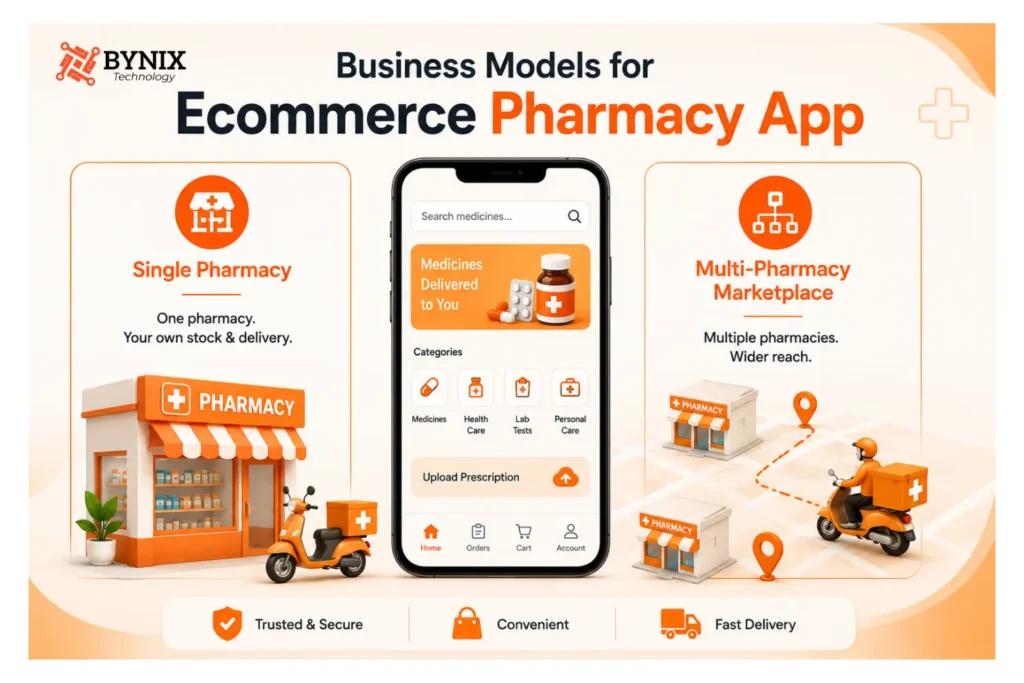
Your software architecture and the way you run your business are determined by your business model. The global digital health market is expected to grow to USD 420.2 billion by 2026, as per data from Grand View Research.
The Single-Pharmacy Model
A tailored ecommerce pharmacy app is suitable for independent pharmacy owners who wish to expand their current physical retail space to a wider local audience online.
- You are in control of your own stock within your current warehouse or shop.
- You use in-house drivers or local courier companies to make your deliveries.
- The application is just like a digital display so you can keep your own customer base.
The Multi-Pharmacy Marketplace
Platforms like 1mg and PharmEasy utilize this aggregator approach. You need not necessarily possess any medical stock.
- You work with a number of local, licensed pharmacies in different cities.
- Users navigate your platform and order medicines, while your backend routing engine assigns them to the closest partner pharmacy.
- You make money by using a percentage commission on each successful sale.
The Subscription-Based Model
This online pharmacy app development model is designed for patients with chronic conditions who need medications to be refilled every month for managing the condition, like diabetes or hypertension.
- Users subscribe on a monthly or yearly basis.
- They are given first delivery, free shipping, or reduced-price teleconsultation services.
- You enjoy high levels of recurring revenues and customer loyalty.
Glance Here: – Telehealth App Development: A Step-by-Step Guide for 2026 and Beyond
What Are the Essential 1mg Like App Features?
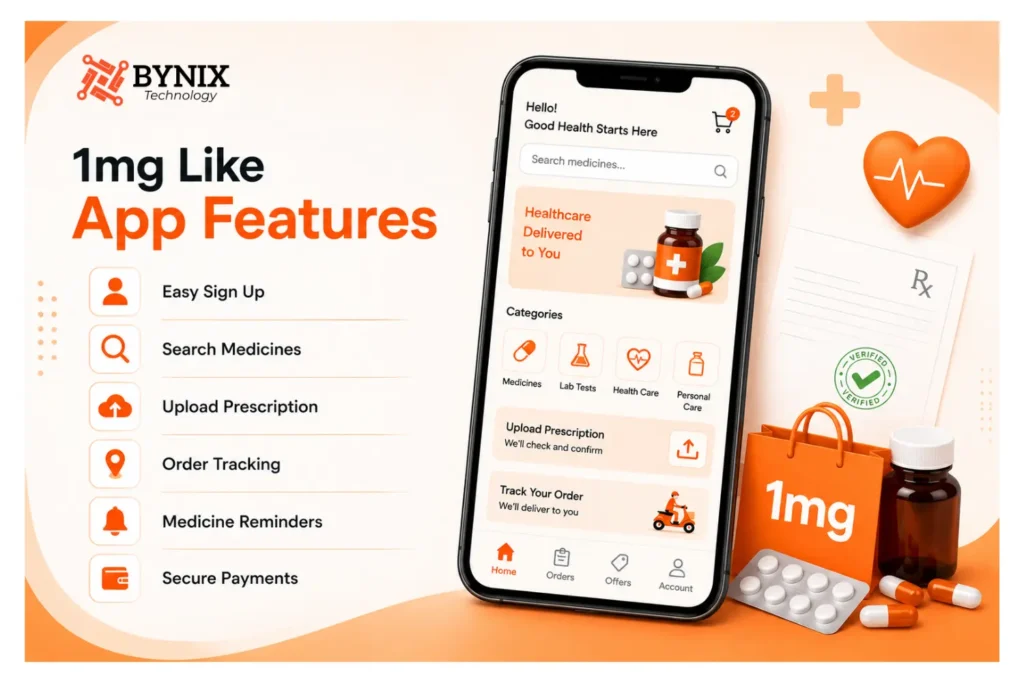
For the digital healthcare platform to run smoothly, four separate interfaces are needed. Customized digital experiences are required for patients, pharmacies, delivery personnel, and system administrators. Connecting the appropriate 1mg like app features makes sure your system runs smoothly, without going through any manual bottlenecks.
Patient Features
Your patient interface must prioritize speed and clarity. Long and complex checkout procedures lead users to drop their carts and stick with their local physical pharmacy.
- Easy Account Registration: Let users register their accounts easily with OTP verification or social media accounts.
- Intuitive Search and Filters: Allow patients to search for certain drugs, see generic alternatives, and filter by brand or price.
- Digital Prescription Uploads: Users can upload a photo of their doctor’s prescription to the cart for pharmacist review.
- Real-Time Order Tracking: Implement live GPS tracking to let users know exactly when their medications are coming.
- Medicine Reminders: Let them schedule reminders to take their daily meds or alerts to remind them to place a refill order.
- Multiple Payment Gateways: Cater to credit cards, digital wallets, UPI, and Cash on Delivery (COD) to ensure that no sale is missed.
Pharmacy Features
Vendors need an easy-to-use dashboard to handle incoming online orders without affecting physical store operations.
- Inventory Management: Enable pharmacies to update the inventory in real-time to prevent patients from ordering out-of-stock drugs.
- Prescription Verification: Ensure a secure viewing portal for certified pharmacists to read and approve user prescriptions prior to dispensing any restricted drugs.
- Order Notifications: Push notifications to alert the pharmacy when a new order is received or for a prescription request.
- Payout Tracking: Provide clear and transparent payout tracking to allow partners to view their weekly earnings and pending payouts.
Delivery Partner Features
To get sensitive medical packages safely and on time, your logistics department requires efficient tools.
- Route Optimization: Incorporate mapping and navigation features to assist delivery staff in plotting the most efficient route to the patient’s home.
- Status Updates: Agents can simply tap on their smartphone and update the order status as “Picked Up”, “Out for Delivery” and “Delivered”.
- Customer Communication: Have a masked calling feature, so that drivers can call customers to tell them what direction they need to go without giving out their personal phone numbers.
Admin Features
For the founders and managers, there is a need for a central command center to manage the whole business and see the health of the platform.
- User and Vendor Management: Enable admins to approve new pharmacy partners, check their licenses, block fraudulent users, and solve customer service tickets.
- Revenue Analytics: Show visual charts of daily revenue, average order value, and subscription growth per region.
- Promotional Controls: Allow marketing teams to generate discount codes, handle referral bonuses, and make seasonal marketing promotions.
How Does 1mg Clone App Development Work?
When developing / building an app like 1mg, it is not necessary to replicate all the features the platform provides. A practical product should mimic the business process of the original product, such as medicine discovery, medicine prescription, medicine fulfillment, payment, and delivery, while incorporating features appropriate for its target market.
Follow this structured process for 1mg clone app development.
1. Market Research and Product Scope
Determine the geographic market and research local competition. Determine if your Minimum Viable Product (MVP) will be just medicine delivery or if you will eventually expand it to include lab test bookings and teleconsultations.
2. Regulatory and Compliance Planning
A digital pharmacy deals with patients’ personal data and regulated pharmaceutical products.
- If you are in the United States, you’ll need to develop HIPAA-compliant server architecture.
- If you are based in Europe, you are required to adhere to data privacy under GDPR.
- If you are in India, you need to follow the Drugs and Cosmetics Act, Pharmacy Practice Regulations, and ensure your data storage is compliant with the DPDP Act 2023.
3. UI/UX Design
The user interface should be neat and clean and present itself as professional and induce medical trust in the user. Keeping elderly patients in mind, you want large typography, high-contrast buttons, and simple navigation menus.
4. Technology Selection
A strong technology stack is essential to a secure and scalable pharmacy platform. Your architecture needs to be capable of supporting a large volume of transactions and safeguarding patient information.
- Role-Based Access Control: This is essential for compliance, as a delivery driver shouldn’t have access to the same detailed medical information as a verified pharmacist.
- Prescription-Document Storage: The backend should securely store and encrypt sensitive user uploads for verification and audit purposes.
- Pharmacy Inventory APIs: These are crucial for integrating the marketplace with the actual stock levels of partner clinics, to avoid the issue of out-of-stock orders.
- Order-Routing Logic: The system should be able to appropriately route the orders to the closest partnered pharmacy that has the necessary stock.
- Scalable Notification Infrastructure: Push notifications and SMS alerts are required to keep the patients, pharmacies, and drivers in sync.
5. Core App Development
During this stage, the developers develop the base code. They create the database structure, develop the administrative dashboards, program the mobile screens for the patient’s side, and create the pharmacy partner portals.
6. API and Third-Party Integrations
Do not build standard communication features from scratch. Incorporate trusted APIs directly applicable to the business process:
- Payment API (such as Razorpay or Stripe): To handle secure payments, subscription management, and automated refunds.
- Maps API (Google Maps, etc): To streamline delivery routes and provide accurate estimated times of arrival.
- SMS/Notification API (e.g., Twilio): To provide direct prescription notifications and order status to the patient’s phone.
- Identity Verification APIs: For safe and secure onboarding of licensed pharmacy partners and delivery drivers.
- Telemedicine APIs: To enable seamless future virtual doctor consultation capabilities.
7. Testing and Security
Testers perform unit testing to ensure that each and every feature functions, load testing to make sure that the servers can cope with heavy traffic, and security penetration testing to identify weaknesses. During their testing, QA engineers make sure that the prescription upload tool performs perfectly on hundreds of smartphone models.
8. Launch and Maintenance
After the QA team has approved the build, the applications are submitted to the Apple App Store and Google Play Store. Once approved, you officially launch the platform and start your digital marketing campaigns. Then, you have to keep an eye on application performance, patch bugs, and release updates.
How Much Does a Pharmacy Delivery App Cost?
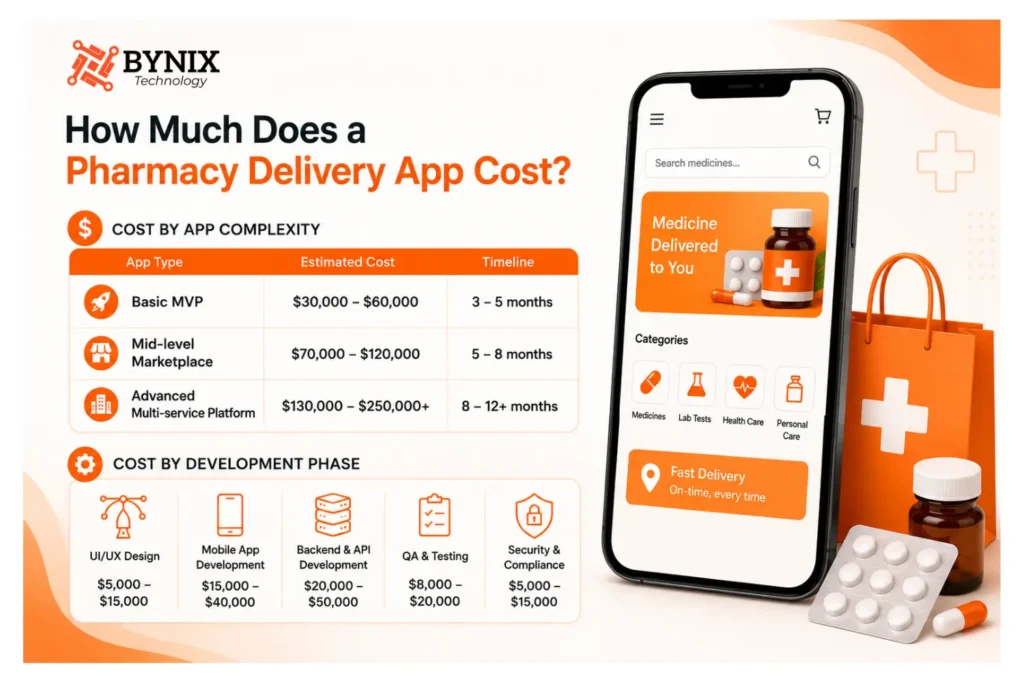
When entrepreneurs plan to invest in custom software, it is crucial that they plan their budget accordingly. The number of platforms, integrations, compliance needs, design complexity, development place, and user roles all play a significant role in the final pharmacy delivery app cost.
Cost by App Complexity
| App Type | Estimated Cost | Timeline |
| Basic MVP | $30,000 to $60,000 | 3 to 5 months |
| Mid-level marketplace | $70,000 to $120,000 | 5 to 8 months |
| Advanced multi-service platform | $130,000 to $250,000+ | 8 to 12+ months |
Cost by Development Phase
It is important to know where the money is being used, so you can use resources effectively during the building stage.
- UI/UX Design: $5,000 to $15,000
- Frontend Mobile Development: $15,000 to $40,000
- Backend & API Development: $20,000 to $50,000
- Quality Assurance & Testing: $8,000 to $20,000
- Security & Compliance Audits: $5,000 to $15,000
Cost by Development Location
The rate of development can vary widely depending on geographical location, seniority, agency model, and technical skills. Founders should choose a team based on their prior experience in the healthcare industry, security measures, communication, and delivery rather than the hourly rate, as teams from India and other cost-effective markets can lower development expenses.
- United States / Canada: $150 to $250 per hour
- Western Europe / UK: $100 to $150 per hour
- India / Southeast Asia: $30 to $80 per hour
Factors That Affect the Final Cost
- App Complexity: The more workflows, the greater the number of hours in development and testing.
- Number of Platforms: Developing for Android is cheaper than developing for Android, iOS, and web admin portals at the same time.
- User Roles: A single-pharmacy app is easier to use than a platform with patients, pharmacies, pharmacists, delivery partners and administrators.
- Third-Party Integrations: Third-party integration of SMS services, map services, identity verification, and payment gateways increases the engineering costs.
If you are not sure whether to scale up your digital presence, read the Top 7 Signs Your Business Is Ready for a Custom Mobile App.
What Challenges Affect Medicine Delivery App Development?
Building a medical platform comes with its own set of challenges. To prevent expensive architectural rewrites, plan for these issues prior to development.
Prescription Verification
Prescription verification processes should be integrated into the platform for medications that require a prescription according to pharmaceutical laws. For instance, Schedule H, Schedule H1, and X drugs require stringent control in India. A backend work process must also be created to put the restricted order on hold until a licensed pharmacist manually reviews and approves the uploaded electronic document. All of this should be verified with competent legal practitioners prior to launching.
Regulatory Compliance
Design, development, audit, and security requirements are more stringent with healthcare compliance. There’s a need to navigate local regulations and laws concerning the sale of digital medicine, data privacy, and pharmacy licensing, while making sure your partner pharmacies are legally authorized to sell medicine online.
Read More: – AI vs Generative AI in Healthcare
Data Security
Cybercriminals are interested in medical records, purchase histories, and prescription details. You need to have security controls in place. Implement end-to-end encryption for all data transfers, secure token-based user authentication for access, and ensure compliance of cloud databases with strong data protection regulations such as the DPDP Act 2023 or HIPAA.
Inventory Synchronisation
Out-of-stock products lead to decreased customer satisfaction and loyalty from patients. For aggregators, you’re required to regularly synchronize your database with partner pharmacies’ inventory management systems, and you want to do this quickly with high-performance APIs.
Delivery and Cold Chain
Some drugs, like insulin or certain vaccines, have to be maintained in a specific temperature range during transport. Your logistics software should take into consideration specialized delivery fleets and only assign cold-chain orders to drivers who have insulated medical transport bags.
How Can You Reduce Medicine Delivery App Development Costs?
Cutting medicine delivery app development expenses does not mean cutting corners on clinical quality. Planning strategically is the key to smart budgeting.
Launch an MVP
Avoid implementing AI suggestions, teleconsultation, lab testing, or complicated loyalty programs simultaneously. Begin with essential functions: register, medicine catalog, search, upload prescription, cart, payment, pharmacy dashboard, as well as delivery tracking. If lab testing is going to be a part of the platform in the near future, see how to build a healthcare app to plan your future roadmap.
Use Cross-Platform Development
Frameworks such as React Native or Flutter minimize the mobile development workload. Having one codebase that can be deployed to both Apple and Android devices saves a lot of engineering hours.
Use Existing APIs
Unless there is a good business case, do not add payment processing, SMS notification, maps, or video calling. By utilizing pre-existing and compliant APIs, you can save your dev team months of complicated coding.
Build for Scalability
Use a modular approach in software construction. This makes it very easy to add more features in the future without breaking the codebase or having to overhaul the system.
Relatable: – Medicine Delivery App Development Cost: Complete Pricing Guide
Conclusion
Building a medicine delivery app like 1mg is not a function of how many screens you are building, but how complex the medicine delivery business is. A single-pharmacy MVP can stay relatively focused, while a multi-pharmacy platform with prescription verification, inventory synchronization, delivery tracking, and healthcare integrations requires a much larger investment.
For most startups, the sensible approach is to get the essential pharmacy operations up and running first; test the market demand and then implement additional features like lab testing, tele-consultation, and advanced analytics based on actual user behavior.
Developing a medicine delivery platform? Look into Bynix Technology’s healthcare app development services to outline your MVP, plan your key integrations, and create a development timeline.
Frequently Asked Questions
1. How much does it cost to build a medicine delivery app like 1mg?
The cost to create a medical delivery platform is in the range of $30,000 to $120,000 for regular applications. A simple MVP would cost less than $150,000, whilst a full multi-service platform with AI recommendations and Teleconsultations would cost more.
2. How long does medicine delivery app development take?
The design, coding, and testing of a focused MVP usually takes 3 to 5 months. Any platform that involves a solid ecosystem and extensive third-party API integration and robust admin dashboards takes about 8-12 months to complete successfully.
3. What features should a medicine delivery app MVP include?
The essential minimum requirements for MVP should be: user registration, a searchable medicine catalog, digital prescription uploads, cart checkout, secure payments, order tracking, and a basic dashboard for the pharmacy partners to accept and process orders.
4. Do I need regulatory approval to run an online pharmacy app?
Yes. Local pharmaceutical regulations and data privacy legislation must be followed. Depending on the e-pharmacy business model and region, specific licenses and retail drug licenses are required, along with strict procedures for verifying digital prescriptions.
5. How can I reduce pharmacy delivery app development costs?
You can reduce costs by building a focused MVP instead of a feature-rich app, using cross-platform development tools, leveraging third-party APIs, and hiring experienced engineers.