

 By
By A doctor appointment app is easy to use from a patient’s perspective: look for a doctor, select a time slot, and confirm the appointment. However, there is a much more complicated system behind that three-step experience. The platform must ensure that providers’ schedules are kept up-to-date, avoid double bookings, manage cancellations, secure patient data, provide timely reminders, and integrate with existing healthcare systems, among other tasks.
This is the distinction between developing a “Doctolib” type platform versus a simple “booking” application. Before you make a decision on a budget or technical architecture, it’s important to understand the various healthcare app types. In this guide, you will learn about the core features, design, doctor appointment app development process, costs, and business models associated with building a successful doctor appointment platform.
For anyone looking to develop a digital health product, the Bynix team can offer custom healthcare app development to help translate your product scope into a secure, scalable application.
What Is a Doctolib-Style Doctor Appointment App?
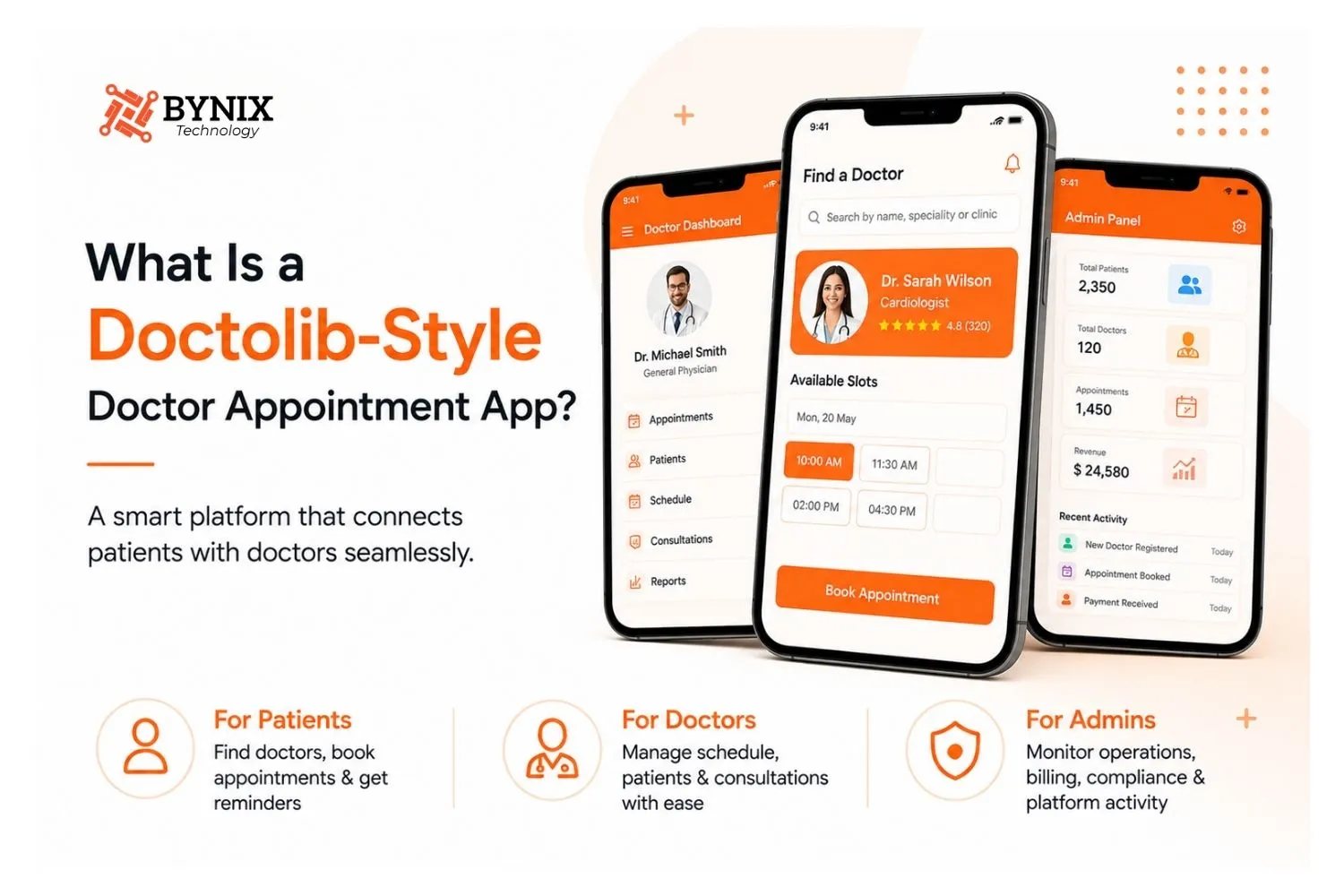
A Doctolib clone app should mimic the marketplace and scheduling model that Doctolib operates on, rather than just replicating its branding or user interface. The platform’s true value lies in how efficiently it connects patient demand with provider supply. Understanding why your business needs a mobile app in 2026 can provide helpful context before you go deeper into industry-specific medical software.
The model can be broken down into three interconnected elements if you want to create a similar platform:
- An app or website for patients to find providers, book securely, and receive automatic notifications.
- A doctor or clinic dashboard to handle day-to-day plans, patient records, and live consultations.
- An admin level that monitors clinic-wide compliance, clinic billing cycles, and platform-wide activity.
Essential Features of a Doctor Appointment App
Your doctor appointment app needs to effectively cater to the needs of three different groups if you want to secure a share of the market that is expected to reach USD 862.16 Million by 2030. Each group requires an extremely personalized digital experience.
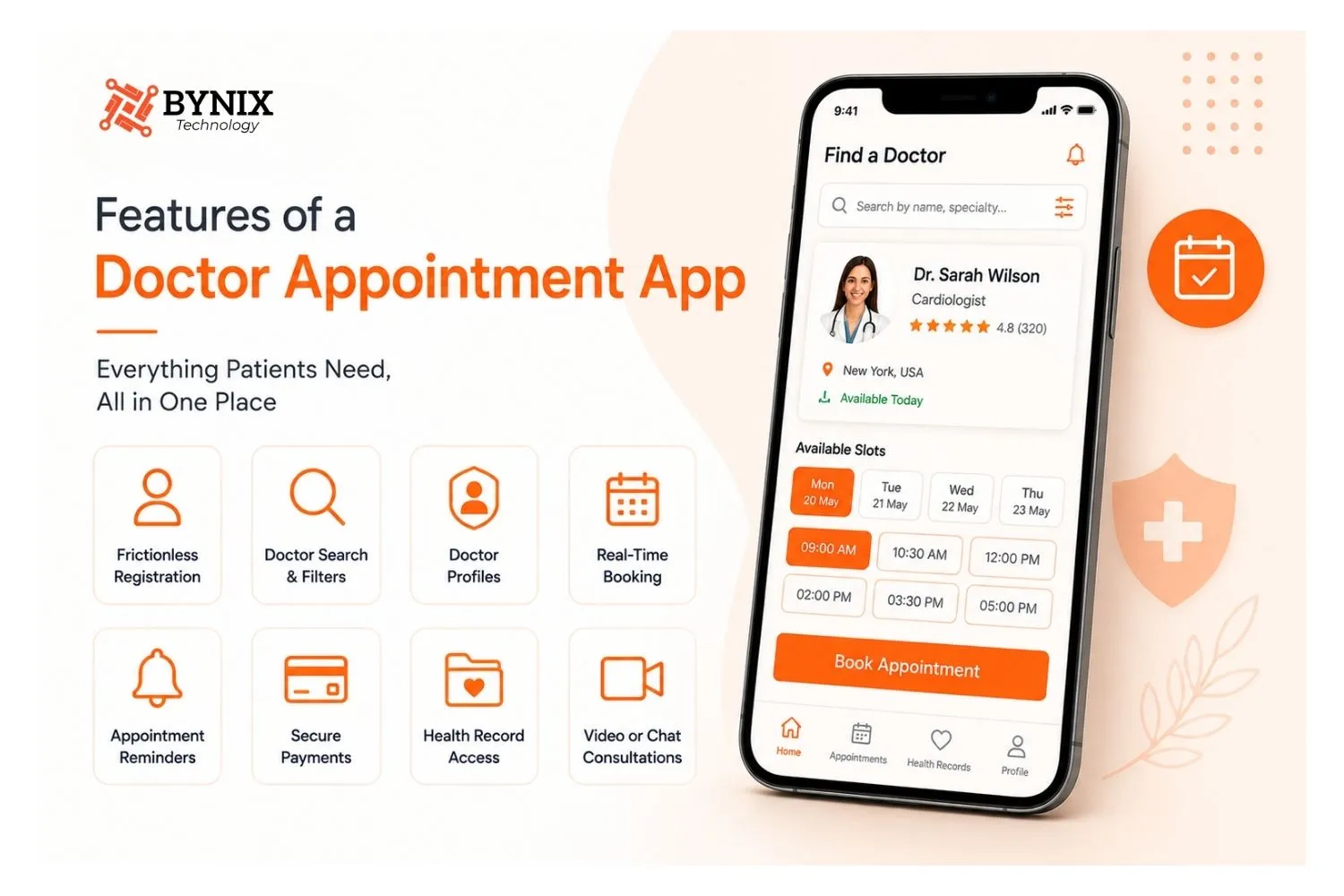
Features Patients Need in a Doctor Appointment App
- Frictionless Registration: Allow users to register via email, phone, or social login, and biometric login (FaceID/TouchID) should be an option for returning users.
- Doctor Search and Filters: Let patients filter doctors by exact specialty, geographic location, spoken language, accepted insurance, and immediate availability.
- Doctor Profiles: Show valid credentials, years of experience, ratings of patients, and detailed information about the clinic.
- Real-Time Booking: Offer real-time calendar availability and allow one-tap rescheduling/cancellation.
- Appointment Reminders: Send out SMS, push, or e-mail reminders just in time to decrease clinic non-attendance.
- Secure Payments: Payment gateways for credit cards and digital wallets to process co-pays and/or consultation fees.
- Health Record Access: Store all past visit notes, active prescriptions, and lab results in a highly secure location.
- Video or Chat Consultations: Allow for safe video or chat communications for follow-up interactions without the need for a physical in-person exam.
Features Doctors Need to Manage Appointments
- Profile Management: Enable doctors to edit credentials, clinic hours, consultation fees, and reply to patient reviews.
- Schedule Management: Offer a daily view of the schedule that includes time blocking, walk-in management, as well as digital bookings.
- Patient History Dashboards: Keep previous visits and notes of the patient clearly displayed before the start of a visit.
- E-Prescriptions: Enable providers to create prescriptions within the app and directly send them to the patient’s preferred local pharmacy Delivery App Development Cost.
- Practice Analytics: View booking volume, no-show rates, and patient retention metrics in one place.
Admin and Security Features for Healthcare Platforms
- Role-Based Access Control: Make sure that the front desk, specialist doctors, and system administrators can only access the information they require.
- Clinic Resource Oversight: Oversee physical room assignments, staff shifts, and complicated multi-doctor scheduling in a single master view.
- Financial Reporting: Track the overall daily revenue, insurance claim statuses, and individual transaction history.
- Audit Logging: Keep a trail of which patient data has been accessed by whom and when it was accessed.
- Multi-Clinic Management: Support platforms that cater to a larger hospital group or franchise clinics, instead of a single stand-alone practice.
How Appointment Scheduling Works in a Doctor Appointment App?
“Patient selects an open slot” may sound simple, but most of your engineering work is behind that single action.
How Doctor Availability Is Managed?
It’s essential that your scheduling engine stores overlapping time variables.
- Doctor Working Hours: Consider regular weekly working patterns, state holidays, and personal leave.
- Clinic Operating Hours: Understand that the clinic’s operating hours can be completely different from the hours an individual doctor works.
- Buffer Times: Include appointment length and buffer times for cleaning rooms or taking notes between appointments.
- Appointment Types: Recognize that the length of a slot varies from a first visit to a routine visit to a minor physical procedure.
How the App Prevents Double Bookings?
A good platform should ensure the integrity of the physician’s calendar.
- Real-Time Slot Locking: Provide real-time slot locking to prevent two patients from booking the same slot at the same time.
- Double-Booking Prevention: Prevent double-booking across a doctor’s entire day by strictly accounting for physical walk-ins.
- Cancellation Windows: Set tight rescheduling policies that will not allow users to cancel 5 minutes before a session.
- Automated Waitlists: Instantly alert waitlisted patients when a previous appointment becomes available due to a cancellation through SMS.
- Recurring Appointments: Support repeating calendar rules, which are widely used in chronic-condition management.
How to Develop a Doctor Appointment App?
Creating a robust scheduling system is not something you can accomplish overnight, and it needs a thorough understanding of clinical operations. Launching without a medical app development process can lead to security issues and inefficient hospital operations. Read our guide on how to build a reliable app to avoid expensive rebuilds.
1. Define Your Doctor Appointment Business Model
Firstly, decide what you want to build: a single specialized clinic, a large hospital network, or an open marketplace between independent providers. Each model is a totally different product scope and determines your basic database design.
2. Map Patient and Doctor Workflows
Go through the patient search, booking, and rescheduling process. At the same time, map how a doctor manages their daily availability on the opposite side. This detailed journey mapping catches scheduling edge cases before they turn into costly engineering bugs.
3. Identify Healthcare Compliance Requirements
Always check with a compliance professional before coding. It is far cheaper to build a secure data foundation from the beginning, instead of adding encryption and audit logs to an existing live database, whether you are looking for HIPAA compliance for the United States or GDPR compliance for Europe.
4. Design the Patient, Doctor, and Admin Interfaces
A separate design pass is needed for each user group and should be readily available. In medical software, UX errors can have serious consequences. An unclear cancellation flow creates empty billable slots, while a confusing calendar interface causes frustrating double bookings.
5. Choose the Right Technical Architecture
Decide on a fundamental database structure, cloud hosting platform, and interoperability protocols (such as HL7 or FHIR) early on. With a solid architecture, your platform will be able to easily support real-time sync and future Electronic Health Record (EHR) integrations.
6. Define and Build the MVP
The perfect doctor appointment app development should start with basic features such as searching appointments, appointment bookings, reminders, and doctor profiles. Add complex AI matching and multi-language support once real usage data validates user demand.
7. Add Payments, Notifications, and Integrations
Add third-party services (such as Stripe for payments, or Twilio for SMS alerts) once the basic booking functionality is completely stable and up and running. Never build your foundational scheduling logic around unfinished external APIs.
8. Test Booking and Calendar Synchronization
Double-bookings and calendar sync failures destroy clinical trust instantly. Conduct extensive quality assurance testing on edge cases, for example, if two patients reserve the same appointment or if an outside calendar doesn’t update in real time.
9. Launch a Pilot and Scale the Platform
Don’t make a full market release; first, release the software to one clinic or a small beta group. This allows you to observe appointment completion rates, identify no-shows, and get rid of workflow friction before scaling to thousands of patients.
Technology Stack for Doctor Appointment App Development
From seamless user interfaces to robust backend systems and secure cloud infrastructure, every component of the online doctor booking app development must work harmoniously.
- Frontend Approach: Cross-platform frameworks such as Flutter or React Native provide excellent support for the patient-facing app. The doctor’s dashboard and administrative dashboard, on the other hand, function more effectively as a responsive web app, as the clinical staff uses it primarily from a desktop computer at the front desk.
- Backend and Server Logic: Real-time scheduling, highly secure authentication, instant notifications, payments, comprehensive reporting, and extensive healthcare integration are all required in the backend. These requirements are met with Node.js, Python, or other backend technologies.
- Data and Interoperability: Structured SQL databases such as PostgreSQL are very good at dealing with defined patient profiles, billing ledgers, and appointment information. When you want to integrate with larger hospital record systems in the future, your back-end architecture needs to be capable of handling HL7 & FHIR.
- Cloud and Security Infrastructure: Make use of a compliant cloud environment provided by a cloud service provider, such as AWS, Google Cloud, or Microsoft Azure. Security is a must-follow aspect of modern digital health app development. These providers have special infrastructures that will be able to help you run HIPAA workloads.
Emerging Technologies for Doctor Appointment Apps
Today, doctor appointment apps go above and beyond simple online booking. Technologies such as artificial intelligence, wearable devices, voice interfaces, and blockchain can improve scheduling, patient communication, remote monitoring, and healthcare data security. The most useful technologies include:
- AI and Machine Learning: Artificial Intelligence algorithms can analyze appointment history, patient preferences, provider availability, and other relevant data to suggest suitable doctors and appointment slots.
- IoT and Wearable Integration: Where relevant and with user consent, doctor appointment apps can integrate with smartwatches and other connected devices to gather relevant health information like activity and heart rate.
- Remote Patient Monitoring: Data from wearable and connected devices can be useful for virtual visits, allowing health care providers to access a patient’s information before or during a visit.
- Voice Search and Natural Language Processing: Voice technology can enable patients to use natural language input to search for doctors, clinics, specialties, or available appointment times, rather than typing all this information.
- Voice-Based Appointment Management: Patients can use voice commands to schedule, reschedule, or cancel appointments, making the platform more accessible for those who may find it difficult to navigate traditional interfaces.
- Blockchain for Healthcare Data: Blockchain-based systems offer another way to ensure data integrity and access control for sensitive healthcare information. But blockchain should be applied only when it’s necessary for the platform’s data-sharing and security needs.
- AI-Driven Appointment Optimization: AI can analyze provider schedules, appointment durations, cancellations, and demand patterns to optimize appointment usage and availability.
How Much Does a Doctor Appointment App Development Cost?
Your doctor appointment app development cost varies based on the number of user roles, the complexity of the scheduling process, compliance regulations, third-party integrations, and the platforms it supports.
The healthcare app development cost can be somewhere around $25,000 for a very specific MVP, and up to $300,000 or higher for an enterprise platform with complex integration.
| App Type | Scope | Cost | Timeline |
| MVP | Search, profiles, booking, reminders | $25,000 to $50,000 | 3–5 months |
| Mid-Tier | Payments, chat/video, e-prescriptions | $60,000 to $120,000 | 6–9 months |
| Enterprise | EHR, insurance, multi-clinic, advanced analytics | $150,000 to $300,000+ | 10–18 months |
There are a few specific cost drivers that often come as a surprise to the founders during the planning phase:
- Compliance Work: When it comes to GDPR or HIPAA-friendly data encryption, detailed audit logging, and legal documentation, the range of costs is $15,000 to $40,000, depending on the project’s complexity.
- EHR/EMR Integration: Integrating with existing EHR/EMR systems is one of the most expensive line items. Legacy hospital systems are not designed for simple API access, and need custom middleware.
- Video Infrastructure: To get video calling working for telemedicine, third-party licensing fees and significant engineering time are required to ensure call quality at scale.
- Annual Maintenance: Spend 15% to 20% of the original build on important security patches, compliance re-audits, and regular operating system updates annually.
When Should You Add Telemedicine to a Doctor Appointment App?
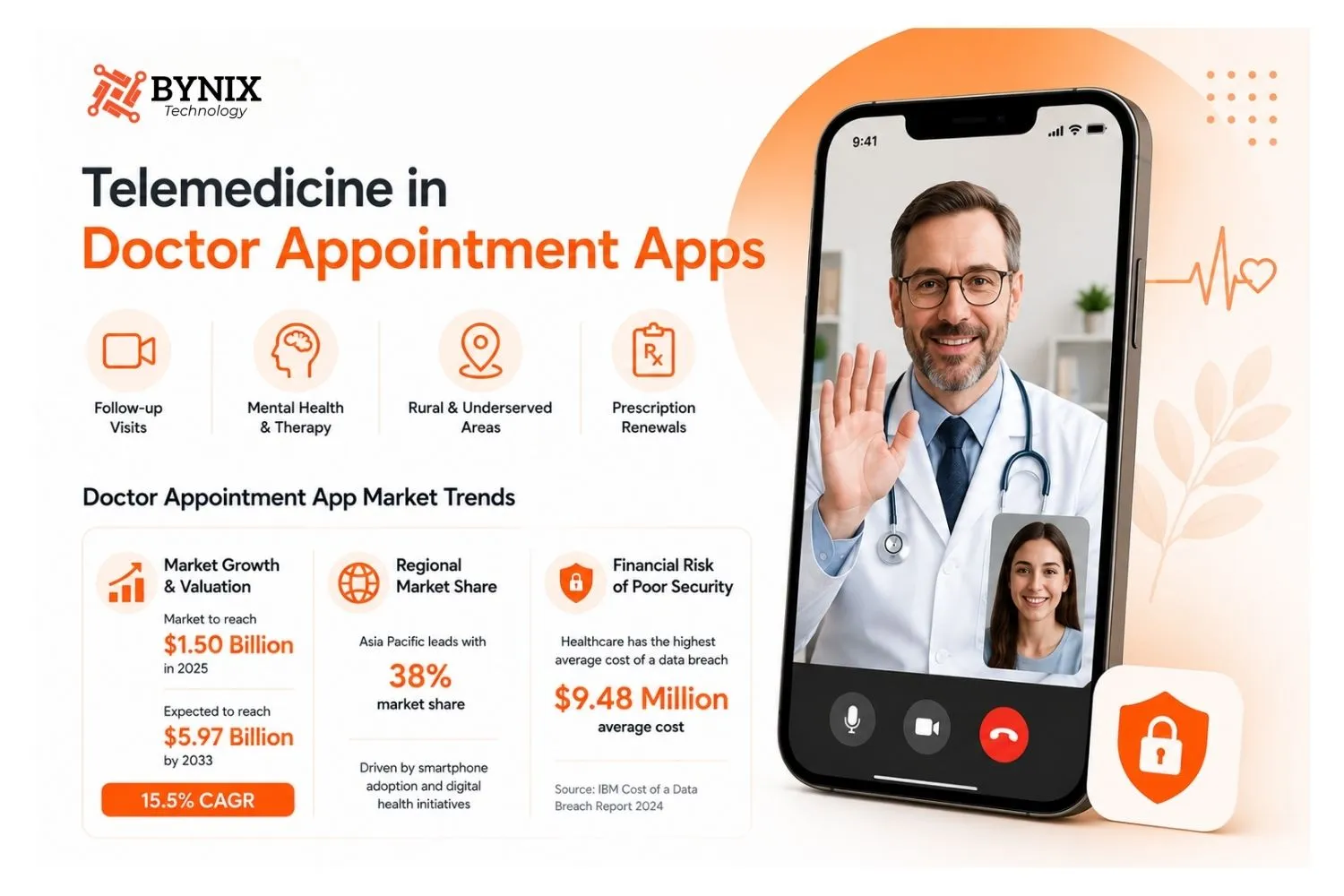
Video consultations are not a necessity for every doctor appointment application at the early stage, but the majority of effective platforms will eventually incorporate it.
A fully functional telemedicine appointment app is most cost-effective for:
- Follow-up visits that do not necessarily need an in-person exam.
- Mental health and therapy platforms, where physical in-person visits often carry more user friction.
- Areas that are rural or underserved, and the nearest specialist is hours away.
- Quick prescription renewals and simple symptom triage.
If you do add virtual care, prioritize call reliability over extra features. While WebRTC and healthcare-specific video SDKs can deliver encrypted real-time communications, the underlying structure of security is completely dependent on the path, method, and location at which media is routed, stored, and processed. A video consultation platform that lags heavily under server load will damage patient trust faster than almost any other bug.
Doctor Appointment App Statistics and Market Trends
- Market Growth and Valuation: The Doctor Appointment App Market is expected to reach $1.50 billion in 2025. The market is expected to grow to $5.97 billion by 2033. This growth is at a 15.5% compound annual growth rate (CAGR).
- Regional Market Share: Asia Pacific is the leading region in the market, accounting for around 38% of the market share. The reason for this regional dominance is the use of smartphones and the introduction of digital health initiatives.
- Financial Risk of Poor Security: Healthcare is the industry with the highest average cost for a data breach. IBM’s Cost of a Data Breach Report 2024 reveals that the average cost of a data breach in the healthcare industry is $9.48 million.
Doctor Appointment App Business Models
The right revenue model will depend on your actual core customer, whether it is an independent clinic, individual patient, or a large hospital network.
- Clinics Pay (SaaS): Clinics opt for a subscription fee, called a SaaS fee, to access the platform, on a monthly or yearly basis. This is an excellent method to make regular and predictable income.
- Patients Pay: Patients pay a direct consultation fee or platform service charge for the convenience of booking or for live telemedicine sessions.
- Marketplace Commission: The platform takes a small percentage fee on each completed booking. This typically happens when the platform is used by a multitude of individual physicians and not necessarily for a single enterprise clinic.
- Premium Provider Visibility: Doctors or clinics pay more for better positioning in patient search results, where legally and commercially appropriate to do so.
- Enterprise Contracts: Hospital groups and larger health care networks pay huge, long-term licensing fees for a deployment specifically designed to their legacy systems and size.
Doctolib is an excellent example of SaaS. Initially, it was a doctor appointment booking platform that grew into software solutions for physicians. At a press conference, the company reported that 300,000 healthcare professionals were using Doctolib’s services per month, with subscription prices beginning at €129 per month.
Doctor Appointment Apps to Research Before Development
It is very important to do competitor analysis to determine exactly what patients and providers expect. The aim here is not to clone these products, feature-for-feature. Research them to see which workflows resonate well with your target market, and which advanced features should be omitted from your initial MVP.
| Platform | What They Provide |
| Doctolib | Provider scheduling logic, doctor discovery filtering, and streamlined practice management interfaces. |
| Zocdoc | Intuitive doctor discovery, complex insurance filtering, and instant booking confirmation flows. |
| Practo | Appointment booking merged effortlessly with telemedicine, diagnostics, and other external health services. |
| MyChart | In-depth, long-term patient engagement and extremely secure, EHR-integrated clinical processes. |
| Teladoc | Virtual-first care routing, triage & on-demand video consultation at enterprise level. |
Common Doctor Appointment App Development Mistakes
The majority of online doctor booking app development projects fail because of entirely preventable planning mistakes. Companies dive into development without any knowledge of clinical workflows, privacy laws and regulations, or even the day-to-day constraints of hospital staff.
Not Designing for Doctors and Clinic Staff
Without doctors and front-desk administrators contributing to the process continuously, the software will not be designed to reflect real clinical processes. If updating a digital calendar is more difficult than the clinic’s old software, the provider will just stop using your application.
Poor Calendar and Booking Management
Double-booking patients at the same hour, or not integrating the app with a hospital’s existing Electronic Health Record (EHR) system, results in significant operational chaos.
A simple Quality Assurance (QA) pass is not sufficient for a medical calendar. The application needs to be subjected to intensive load testing and functional testing to discover scheduling edge cases and time zone conflicts prior to the application becoming live.
Adding Too Many Features to the First Release
Companies spend too long developing intricate healthcare appointment app features, such as advanced telemedicine video routing or AI symptom checkers, even before the core scheduling platform has been fully stabilized.
A bloated application confuses users and complicates testing. Build a specific Minimum Viable Product (MVP) and get feedback from real patients before adding additional functionality.
Failing to Track Appointment No-Shows
From the beginning, your backend system should keep track of cancellation trends, patient preferences, and doctor utilization. This particular information is crucial for ongoing optimization of your automated SMS reminders and smarter waitlist routing.
Conclusion: Building a Doctor Appointment App Successfully
The task of building a doctor appointment app, like Doctolib, is essentially a complex problem of scheduling and marketplace. Patients require lightning-fast, on-demand booking while doctors desire calendars they can rely on.
The best business strategy is to start with the workflows that will deliver immediate value, such as provider discovery, correct availability, booking, reminders, and doctor-side schedule management. Then, as the product becomes more popular, telemedicine, deep insurance verification, EHR connectivity, and powerful AI automation can be added.
Looking for a healthcare app development platform? Consult the professionals at Bynix to clarify your MVP, your development timeline, third-party integration needs, and your budget. By working with an expert healthcare app development company like Bynix, you can ensure your product launches securely, compliantly, and successfully.
Frequently Asked Questions About Doctor Appointment Apps
How much does it cost to build a Doctolib clone app?
A basic MVP can cost you about $25,000, and a midsize platform with video consultations and payments can range from $60,000 to $120,000. Depending on the scope of the doctor appointment app development cost, an enterprise platform with EHR integration and multi-clinic support can cost you $150,000 to $300,000.
What does the medical app development process look like?
It includes market discovery, mapping out healthcare compliance requirements, and creating specialized interfaces for patients and doctors. After that, choose the appropriate cloud infrastructure, and thoroughly test the platform’s booking engine before deployment to the market.
What healthcare appointment app features are essential?
For starters, patients require detailed doctor search, real-time booking, automated reminders, and secure payment methods. A doctor needs to have the ability to see patients’ history and manage their schedules. Admins need role-based access control and financial reporting.
Which healthcare app types are most profitable?
Marketplace booking apps, remote patient monitoring, and telehealth products generally have higher return potential as long as they can provide value to patients on an ongoing basis.
How do I choose the right healthcare app development company?
Find an agency with a solid track record in medical software, a robust understanding of HIPAA and GDPR compliance, and familiarity with clinical processes. It’s important for them to focus on data security and calendar architecture.
2 Comments