

 By
By In the current virtual-first world, organisations are frequently moving towards mobile platforms for uplifting customer engagement, improving sales, and strengthening brand presence. As smartphone usage is frequently rising globally, having a business mobile app development isn’t a luxury. It has become a necessity for organisations of all sizes. Whether you run a startup, retail store, or healthcare company, investing in custom mobile app development company, firms, organisation or agency can significantly impact your growth in 2026 and beyond.
Currently, businesses are not competing on products but on offering personalisation, experience, and virtual user experience. With billions of smartphones available, mobile apps have become the core tools for organisational growth. If you are still relying on traditional platforms, you’re missing out on massive opportunities. So, Custom E-commerce App development is a strategic investment that accelerates engagement, revenue, and long-term customer relationships.
The Rising Necessity of Mobile Apps in 2026
Mobile devices have become the primary method people use to interact with organisations online. Consumers use smartphones for banking, shopping, entertainment, and healthcare. The well-designed application by a mobile app development company offers a direct communication channel to customers, allowing customised experiences and access to products.
Organisations that fail to adopt mobile technology risk losing customers. Mobile apps have transformed the way we consume virtual media, accounting for 70% of virtual engagement. Here are a few statistics that show the rise of App development for business in 2026-
- Users basically spend 4.8 hours a day on mobile apps, whereas 1.5 hours are spent on mobile websites only. Apps keep users engaged 3 times longer than the sites.
- Mobile apps increase conversions by 2 times compared to mobile web browsers.
- Reports by MindSea states that Gen Z spent 71% of their time on smartphones.
- Globally, the rate of app installation increased to 10%, whereas app sessions rose by 7%, showing continued growth.
- The worldwide mobile app revenue is touching new heights; the market generated more than $950 billion in 2026.
- On average, users spent 5.3 trillion hours in mobile apps during 2025, highlighting how deeply our apps are integrated into our daily lives.
Features that are not accessible in the custom website limit your growth
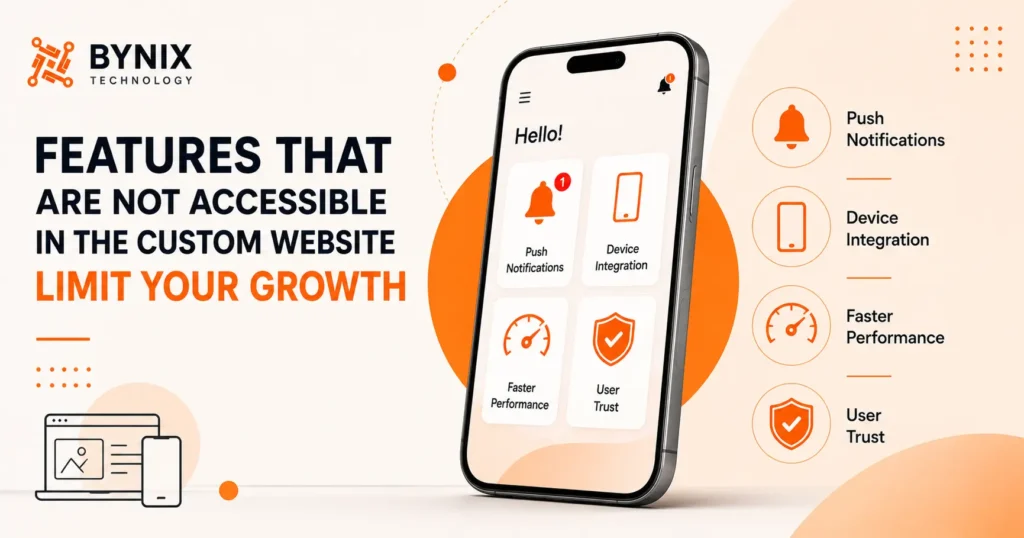
- Push notifications- The average click rate of push notifications is 7.8%. When a business wants to tell its customers about flash sales, order updates, or booking reminders, then push is the easiest option. A website can’t send push notifications, whereas an app can send these to its users anytime.
- Device integration- The apps have comprehensive access to device hardware that sites can’t match. It has use cases that aren’t accessible on the web, such as barcode scanning, augmented try-ons, and contactless payments.
- Faster performance- Native & well-designed hybrid apps consistently outperform sites on speed & smoothness. In apps, animations are top-notch, transitions feel instant, and user experience drives retention.
- User trust- Having your app on the home screen is a good way to grow trust. The average smartphone can have up to 80 apps installed, but only a few of them are used frequently. Getting your business app into the regular use category builds a loyalty loop that is hard to break.
Key benefits of mobile app development for business
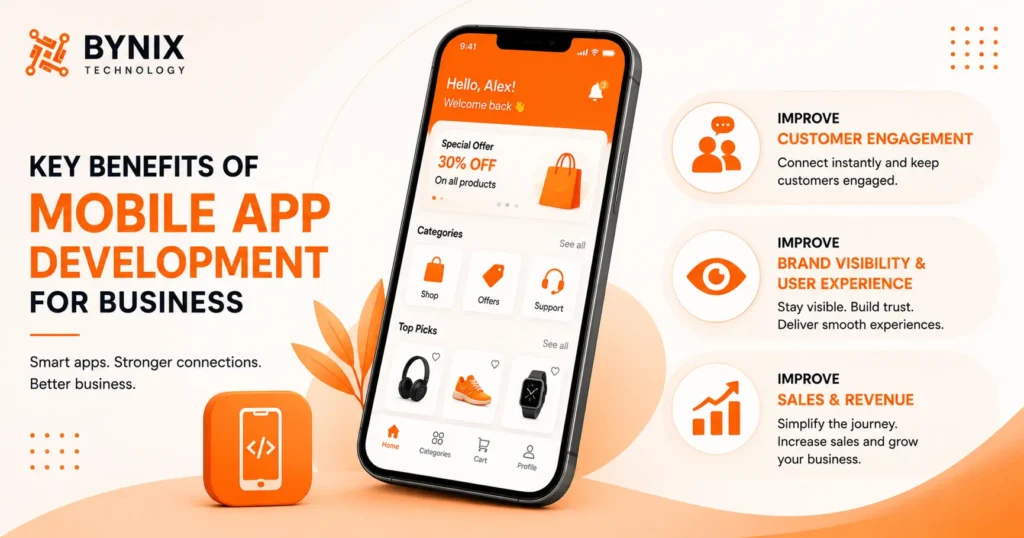
- Improve customer engagement
The biggest benefit of Android app development is direct communication with customers. Through push notifications, organisations can instantly update users about discounts, promotions, product launches, and service upgrades. Unlike emails, which are often unread, mobile notifications have significantly higher engagement rates. A well-designed business app creates strong customer relationships and keeps them connected with your brand.
- Improve brand visibility and user experience
Customers use their smartphones various times in a day. Having your app icon visible on screen frequently reminds them about your business. This consistent visibility improves brand recognition and builds consumer trust. Organisations investing in custom mobile app development often experience strong brand loyalty compared to organisations relying on sites. Additionally, when businesses hire an app developer, they get a smooth & faster user experience compared to sites. It has customised dashboards, easy navigation, secure login systems, real-time support, and faster performance.
- Improve sales and revenue
Through mobile app development services, businesses can simplify their user journeys. With features like one-click purchases, integrated payment gateways & customised suggestions, apps help businesses to improve conversions. For e-Commerce organisations, mobile apps can limit cart abandonment, enhance user retention, increase repeat purchases, and improve the shopping experience. This is the reason why businesses are partnering with an app development company.
Choose the next platform for your mobile app development
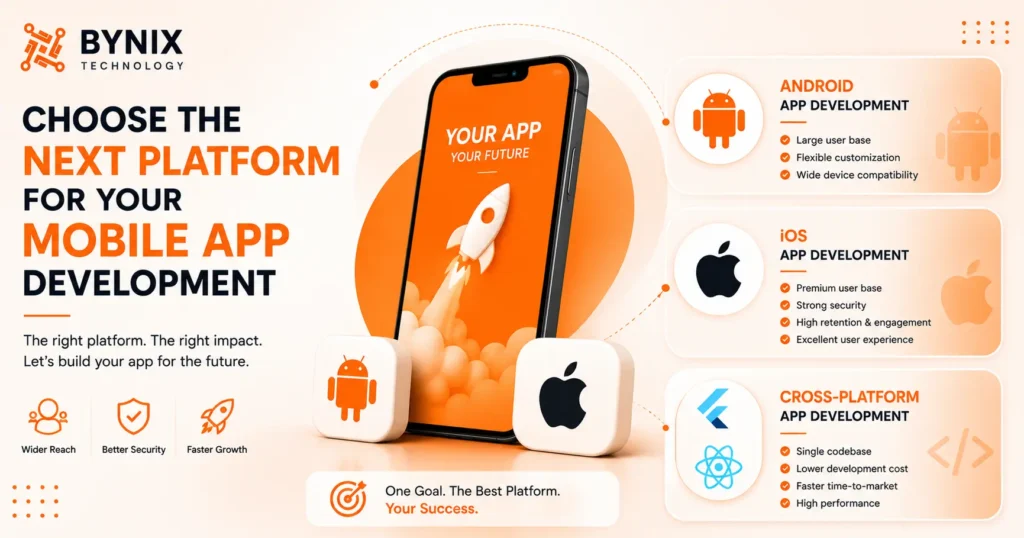
Android app development- The best mobile app development services in India allow firms to reach a vast worldwide audience. Android holds a significant share of the mobile market & delivers flexibility across various devices and price ranges. The benefits involve a large user base, flexible customisation, and device compatibility.
iOS app development– These development practices target Apple’s premium user base. iPhone users often evaluate high engagement and habits. The iOS app development platforms are chosen due to their strong security, high user retention, faster adoption, and excellent user experience.
Cross-platform app development– Many organisations choose cross-platform app development to develop apps that work on both Android and iOS using a single codebase. Cross-platform solutions reduce development costs and accelerate release values while maintaining high performance. The most popular frameworks for development are Flutter Vs React Native.
Flutter Vs. React Native cross-platform app development- which is better?
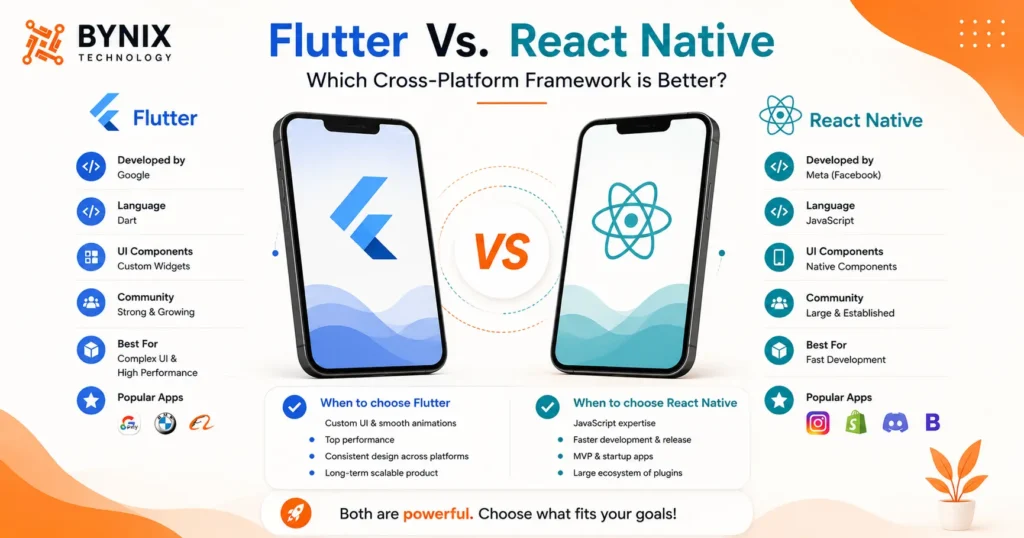
| Feature | Flutter | React Native |
| Developer | Developed by Google | Developed by Meta (Facebook) |
| Programming Language | Dart | JavaScript |
| UI Components | Uses its own customizable widgets | Uses native platform UI components |
| Community Support | Strong and rapidly growing | Large, mature, and well-established |
| Testing Support | Built-in testing tools available | Relies more on external testing libraries |
| App Size | Typically larger application size | Generally smaller application size |
| Best For | Complex UI, animations, and high-performance applications | Faster development, MVPs, and JavaScript-based teams |
| Popular Apps | Google Pay, BMW, Alibaba, eBay Motors | Instagram, Shopify, Discord, Bloomberg |
When to choose Flutter
- You require customised UI & smooth animations.
- Performance is a top priority of Flutter app development.
- You need a consistent design across iOS & Android.
- You are building a long-term, scalable product.
When to choose React Native
- Your team has expertise in JavaScript.
- You require faster development & release.
- If you are building an MVP and a startup app, choose React Native app development.
- You need access to a large ecosystem of plugins & libraries.
Flutter is basically preferred for performance-driven apps with custom UI, whereas React Native is good to choose for organisations that have high skills in JavaScript and want faster development. Both are good in their own way, and the choice depends on your technical requirements and project goals. Choose affordable mobile app development for startups.
Steps to build a mobile app for your business in 2026
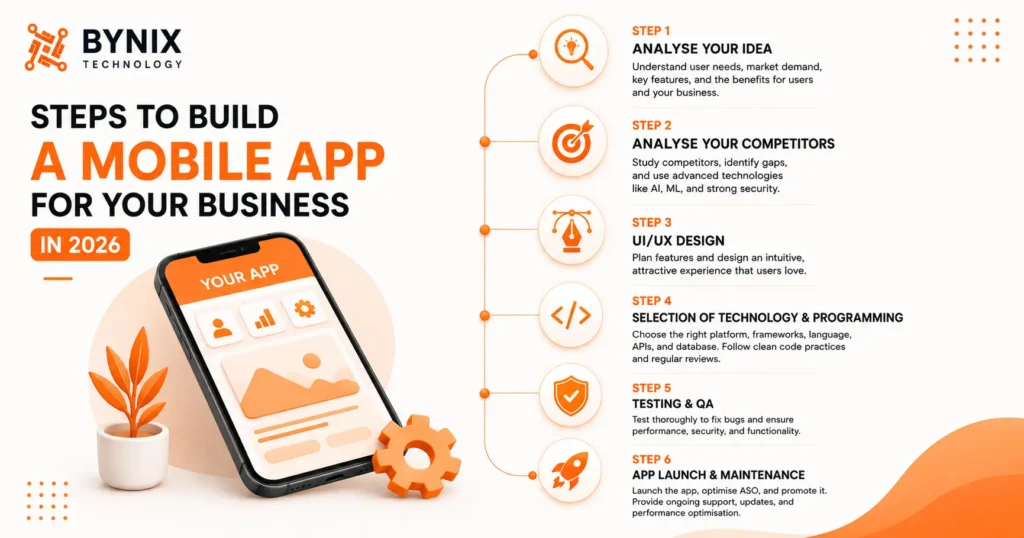
Here is the step-by-step approach on how to build a mobile app for my business.
Step 1- Analyse your idea
A concept of app building isn’t enough; what really matters is understanding the real needs of users and the market. Ask yourself the following questions before collaborating with a mobile app development company for a small business.
- Define which issues you want to navigate through the app.
- List your targeted users.
- What benefits can users and your company gain through the app?
- What key features do you want to include in your app?
Without a good understanding of these factors, the best idea might fail.
Step 2- Analyse your competitors
Analyse your competitors in the market to ensure your idea is unique. Check the features your competitors also have? What are the gaps they have? What are the advanced technologies they have used? Modern mobile apps must have advanced security systems, AI integration, and ML.
Step 3- UI/UX design
Develop a plan and define with your team what features need to be integrated. A well-organised plan by a mobile app development agency for startups saves time & money. Additionally, UI/UX design is the stage where the UI and UX are planned & developed. Quality design requires understanding user needs and being familiar with current design trends. An intuitive & attractive design improves the chances of app success.
Step 4- Selection of technology and programming
This is the stage where the development team turns your idea and designs into a realistic product. The Custom Android and iOS app development services provider decides the platform, choice of frameworks, language, integration with APIs, and database, and frequent code reviews. The well-planned process avoids delays.
Step 5- Testing & QA
This is an essential step to enable errors to be monitored and resolved before release. Thorough testing verifies the performance, security, and functionality of any app. The more accurate the app works, the better the chance of receiving positive user feedback.
Step 6- Mobile app launch & maintenance
The process of mobile app launch by the best mobile app development services in Jaipur takes 7 days. The team prepares promotional materials, optimises ASO, and develops a promotional strategy. The key is to regularly update the app, monitor performance, and respond to user needs. The team offers technical support, offers frequent security updates, and optimises performance.
Cost & time required to develop your next enterprise mobile app
Want to know how much does it cost to build a mobile app & how long does it take to develop a mobile app? So, the cost depends upon the complexity, features, platforms, and integrations, and the development team’s location. Here is the cost breakdown for 2026-
| App Type | Features Included | Estimated Development Time | Estimated Cost (USD) |
| Basic App | Login, user profile, simple UI, basic functionality | 2–4 months | ₹1.5 lakh to ₹8 lakh |
| Medium Complexity App | User accounts, payments, APIs, push notifications, analytics | 4–8 months | ₹8 lakh ₹20 lakh |
| Complex App | Real-time chat, GPS tracking, advanced integrations, custom dashboards | 6–12 months | ₹20 lakh to ₹50 lakh |
| Enterprise App | AI features, cloud infrastructure, high security, scalability | 9–18+ months | ₹50 lakh to ₹1 crore |
Organisations can often limit development cost by 30-40% when they choose cross-platform app development using Flutter or React Native. This approach enables a single codebase to be used on various platforms, reducing development and maintenance efforts.
Summary
In 2026, organisations that adopt a mobile-first approach will stay in the competition. A mobile application isn’t a virtual asset but a powerful growth engine that drives engagement and revenue. From enhancing user experience to unlocking new monetisation opportunities, having a mobile app is good for positioning your business for long-term success. To build your next app, collaborate with the best mobile app development services in Rajasthan.
Why is having a mobile app necessary for business in 2026?
Mobile applications support businesses to enhance customer engagement, improve brand visibility, offer a personalized experience, and establish direct communication channels with users. As mobile usage continues to rise, apps offer a convenient way for retail users.
When does my business need a mobile app?
If your business frequently engages with customers, offers services online, and wants to enhance user experience, building a mobile app offers significant values and supports long-term growth.
What features must a mobile application have in 2026?
The essential features a mobile application must have are user registration, secure payment transfer, push notifications, customized recommendations, and seamless integration with current business systems.
How much does it take to design an application?
The cost of mobile app development depends on factors such as app complexity, platform requirements, design needs, integrations, and custom features. Simple apps cost less, whereas feature-rich enterprise apps require more investment.
What steps are included to build a mobile app?
Before you collaborate with any partner, start identifying your business goals, target audience, and required features. Develop a roadmap, select the ideal tech stack, and partner with an experienced team to design, build, test, and launch the app successfully.
3 Comments