

 By
By Turning a concept into a successful digital product involves a blend of strategic planning, rigorous coding and an understanding of the way users behave. All great platforms start with a simple question: What problem am I trying to solve for my audience?
Now, if you are prepared to take this trip, the most important step towards creating a product that resonates with the market is finding reliable mobile app development services. We eliminate all the unnecessary complexity and produce solutions that users will love to have on their phones.
Ideation and Market Research: Where It All Starts
It’s important to have a clear goal in mind before you actually begin coding. One of the top questions asked by many entrepreneurs is “How to build a mobile app for my business?” It starts with lots of market research and getting to know your audience. Don’t get too attached to that idea; consider what issues your users have in their everyday lives.
Understand the market you want to go into and draw a basic first draft plan, using frameworks such as the Lean Canvas. Partnering with a reliable mobile app development company helps clarify some early decisions and prevents your product roadmap from becoming unrealistic.
Your unit economics needs to be determined at the beginning. By comparing your Customer Acquisition Cost (CAC) and Customer Lifetime Value (LTV), you can easily see your profit margins. We go over these less complicated metrics so that you don’t have to use more complicated math, but at least you know that your idea is financially viable. When you invest in app development for business, it provides a solid foundation for various operations from the very first day.
Competitor and Market Analysis
Perform a SWOT analysis to find out your strengths, weaknesses, opportunities and threats. Know your strengths and weaknesses, and know the bottom line of your market position. Monitor primary competitors that are targeting your specific audience, as well as secondary competitors with alternative solutions.
- Analyse the profitability of categories and growth in installations.
- Know the age demographics and geographic location of top users.
- Pay attention to the things that people like or don’t like in competitor reviews.
Prototyping: Build It Before You Code
Before coding, you need to draw out how your platform will work. Imagine wireframes as the architect’s blueprint for a house. Remove all the screens down to their essential action. The more taps that are needed to complete tasks, the lower the completion rates and the higher the cognitive load.
Imagine the interface to be a coffee shop counter. The front space must include the obvious choices for 80% of the customers. The back counter must take care of edge cases and deep customisation. If you crowd the front counter, all the customers slow down.
At this phase, it is important to prioritise platforms according to the intended target market. From iOS app development with clean, controlled and composed interfaces for high-value markets to Android app development with flexible layouts and interfaces for a broad audience across the world, simplicity is your best option. Design governance ensures that features are kept to a minimum. Do not add anything new to the prototype without an explicit user hypothesis.
Realistic Timelines and Budgets
When building an app, one of the most common questions entrepreneurs have is “How long does it take to develop a mobile app?” It depends on the features you need, the platform you’re selecting, and your team’s experience.
| App Type | Included Features | Estimated Timeline |
| Simple App | Basic features, minimal integrations | 2-4 months |
| Standard App | Moderate features, API integrations, user accounts | 4-7 months |
| Complex App | Advanced features, multiple third-party integrations | 7 months |
Locking down your scope early allows you to reduce the risks. Obviously, the next big question is “How much does it cost to build a mobile app?” The price varies depending on the complexity and location. The best way to manoeuvre these monetary variables is to associate with a mobile app development company for small businesses, which will supply you with a quality product without utilising your startup capital.
UI/UX Design: Prototyping and Visual Identity
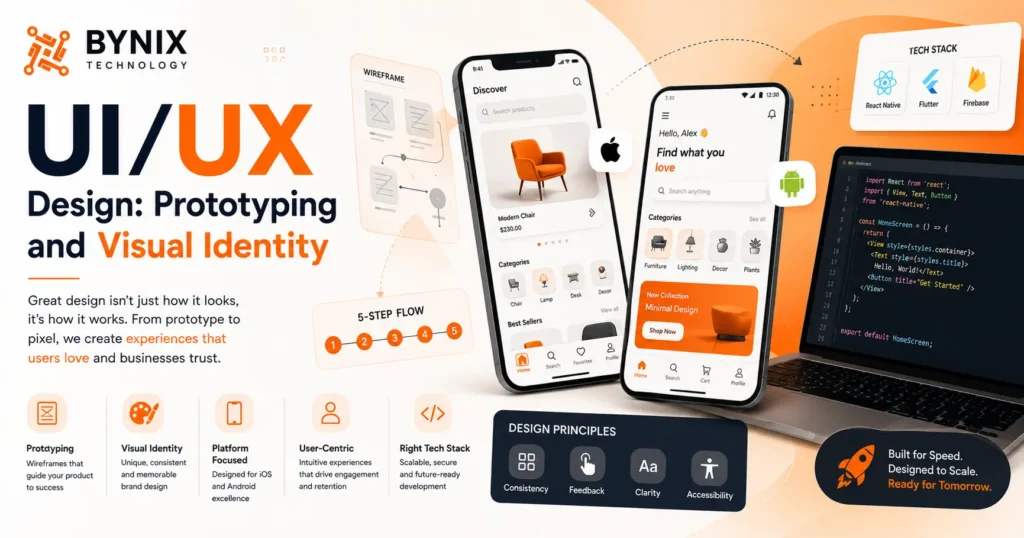
Design determines retention and consequently affects your revenue. According to statistics from Itransition, 70% of mobile users leave an application because of its poor design. Wireframes are like blueprints for your digital product.
When you invest in custom mobile app development, you prioritise the user journey. Performance has a huge impact on user experience. Perceived speed should be considered a design factor, not an engineering afterthought.
Designing for Different Platforms
Each tap should have a visual or haptic feedback or sound to let users know that the system registered their intent.
- Designing for iOS: Apple values consistency. It’s important to create interfaces that are clean, composed, and use predictable navigation and clear typography.
- Designing for Android: Google offers flexible and adaptive layouts that support foldables and other aspect ratios.
- Pro Tip for AI Design Generation: When asking an AI tool to create screens, start with flow first, then pixels. Give a detailed 5-step user flow (with specific constraints to minimise the number of revision cycles).
Development: Selecting the Right Tech Stack
With approved designs, you move into the core engineering phase. Select the technology that enables delivery cadence and technical expense of divergence, and not just developer preference. You have to apply strict mobile app development practices to keep the architecture clean, scalable and easy to update.
Tech Stack Comparison
| Approach | Best For | Pros | Cons |
| Native (Swift/Kotlin) | Complex, high-performance needs | Deep device integration, smooth UX | Higher cost, longer development time |
| Cross-platform app development | Startups, rapid market entry | Shared codebase, faster development | Slight performance trade-offs |
Native solutions offer better performance, quicker animation, and smooth hardware integration, such as Face ID or Apple Pay.
But if your plan involves quickly testing several operating systems at a time, you’ll find that Flutter app development or React Native app development can offer significant performance benefits with a single codebase. This not only reduces development time but also ensures a native experience.
Building Your Engineering Team
The key to flawlessly carrying out this phase is having the right talent. Some companies opt to hire an app developer to help them with their in-house work.
- In a startup scenario with limited funds, a mobile app development company for small businesses will make sure that the architecture scales safely without burning through the capital.
- When it comes to enterprise-level quality, look for specialist partners. For example, when it comes to app development for business, data security and smooth API integration are paramount.
- Geolocation also has a part in locating the best candidates. Many global brands seek the best mobile app development services in India to balance cost and exceptional technical proficiency.
- Even regional tech hubs can be of tremendous value; the best mobile app development services in Rajasthan offer access to innovative engineering teams that produce world-class code.
Analytics and Testing: Break It Before Users Do
Testing is the difference between a buggy release and a 5-star application. Real users do not follow ideal pathways. They tap unpredictably, switch networks constantly, and use older devices.
Implementing Analytics Early
Consider analytics to be your product’s eyes and ears. You can use something like Firebase Analytics, Mixpanel, or Amplitude to find out where your users are getting stuck. People will delete your software if it crashes a lot. To track stability, use crash reporting tools such as Sentry or Crashlytics.
Comprehensive Testing Strategies
You need to run multiple testing protocols to guarantee stability:
- Unit Tests: Developers test small, isolated sections of code to see that they produce the correct data.
- UI Tests: QA engineers test the functionality of the screen elements, such as buttons, screen transitions, and input fields, to see if they function according to design.
- Performance Testing: Testers execute the software on slow networks and older hardware to find out any bottlenecks.
- Beta Testing: Have a few non-technical friends or Beta testers do the testing on your main flows. If they get stuck, you know exactly where to fix the friction.
Set up hard release checklists, visual regression reports, and accessibility conformance. When you assign a dedicated design owner to sign off on features, you eliminate the confusing approval loops that slow down your launch.
Launch and Post-Launch Evolution
You’ve gone through all the testing, and now you’re finally ready to release your product to the App Store and Google Play. However, launch day represents the starting line, not the finish line.
- You need to write a great store description. Create a clear, compelling description, provide high-quality screenshots and create an engaging preview video.
- Once your product is live, monitor user feedback obsessively. Monitor Key Performance Indicators (KPIs) and listen to your community.
- Treat your application as a living entity. Set up regular syncs to tweak the components, refresh your design system, and introduce new features, using real data instead of assumptions.
Monitor your analytics dashboards, and continuously evolve your digital product to keep your users engaged for years to come. In this process of solving real problems and focusing on the end user experience, you create a digital product that people will love to use.
How long does it take to develop a mobile app?
Simple apps take 2-4 months, standard apps take 4-7 months and complex apps with high grade third party integration take 7 months or more.
What are the most important steps to take before writing any code?
You need to do deep user research, understand your competitors and know your unit economics (such as CAC, LTV) before coding. A wireframe or prototype should be created to see the basic user flow and to reduce cognitive load.
Should I choose native or cross-platform app development?
If your app needs to integrate heavily with hardware, select Native development (Swift/Kotlin). If you are a startup that wants to get to market quickly, save money, and leverage a common code base, choose Cross-platform development (React Native/Flutter).
Why do users abandon or uninstall mobile apps?
70% of users leave an application because of poor UI/UX design or a confusing onboarding experience. If your product is technically unstable, slow to load, your users will soon uninstall your product.
How do I decide which features to prioritize for my MVP?
Potential features can be divided into basic needs, performance features, and delighters. Use the paired question technique in user research to uncover what features are “must have” and what is “nice to have”.
2 Comments