Legacy System
MODERNISATION SERVICES
Your legacy system built your business, but now it is limiting your scalability and operational efficiency.
Due to evolved modern technologies, outdated software holds back growth. Bynix helps businesses modernise outdated software, migrate ageing infrastructure, and rebuild technical foundations without disrupting what's currently running.
Get a Free Legacy Assessment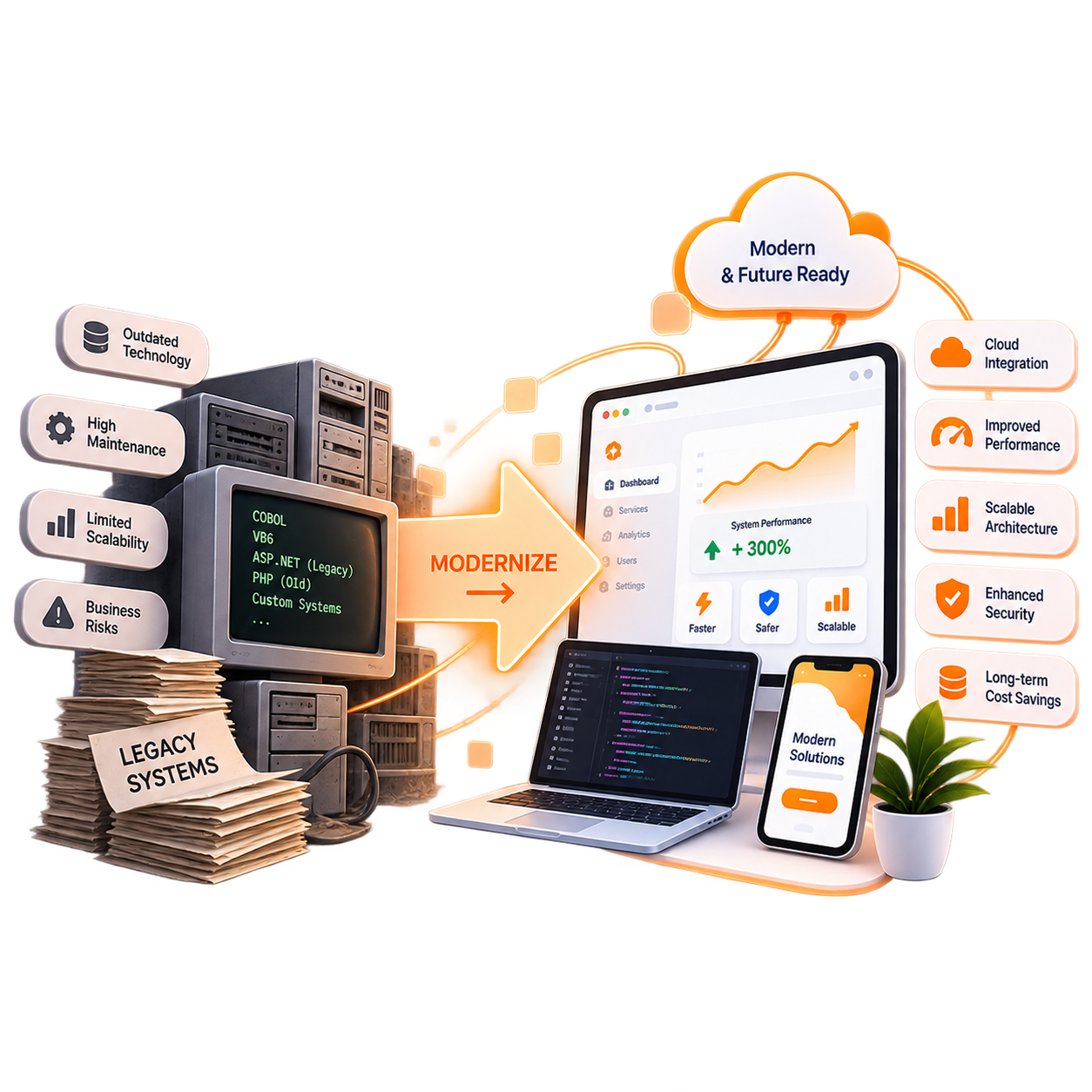
Legacy System Modernisation
FOR MODERN TECH REQUIREMENTS
Bynix begins app and software modernisation with an honest assessment. Not every legacy system needs a full rewrite. Some need targeted refactoring. Some need cloud migration. Some need a phased re-architecture that keeps the business running throughout. We identify the right approach before recommending one.
Legacy System Modernisation
SERVICES WE OFFER
Bynix covers every layer of legacy modernisation from consulting and assessment through execution and post-migration support.
Application Re-platforming
We move your existing application to modern infrastructure cloud platforms, containerised environments, and managed services — with minimal changes to the core application logic. Faster than a rebuild, more impactful than a rehost.
Code Refactoring & Re-engineering
We restructure legacy codebases to improve maintainability, performance, and extensibility without changing external behaviour. The application does the same things. It just does them on a codebase your team can actually work with.
Monolith to Microservices Migration
We decompose tightly coupled monolithic applications into independently deployable microservices. Each service owns its data, scales independently, and can be updated without touching the rest of the system.
Cloud Migration & Modernisation
We migrate on-premise systems and legacy infrastructure to AWS, Azure, or GCP — with architecture designed for cloud-native performance, auto-scaling, and cost efficiency from day one.
Database Modernization
We migrate outdated database systems, Oracle, MS SQL 2005, and legacy MySQL to modern database architecture. PostgreSQL, MongoDB, Redis, Snowflake selected based on your data structure, query patterns, and scale requirements.
API Development & Integration
We build modern API layers around legacy systems, enabling integration with current platforms, third-party services, and data pipelines without requiring a full system rebuild.
UI/UX Modernisation
We rebuild outdated interfaces on modern frontend frameworks, React, Angular, and Vue, while preserving the backend logic the business depends on. Users get a modern experience. The core system keeps running.
Legacy System Assessment & Consulting
Before any modernisation work begins, we audit your existing system codebase, infrastructure, integrations, data architecture and produce a prioritised modernisation roadmap with approach recommendations and realistic timelines.
Signs Your Legacy System Is HOLDING YOUR BUSINESS BACK
Most legacy systems don't fail suddenly. They slow you down gradually until the cost of staying is higher than the cost of modernising. Here's what that looks like in practice.
New features take months
Every change touches too many interconnected parts of a codebase that was never designed for modification.
Your team maintains more than they build
Developer time is consumed by patches, workarounds, and keeping the existing system stable.
Integrating with modern platforms
Connecting to current APIs, cloud services, or third-party tools requires custom middleware that breaks regularly.
Security patching is delayed because changes break things
Known vulnerabilities stay open longer than they should. After all, the system is too fragile to touch safely.
Compliance requirements
Regulatory standards have moved. The architecture hasn't. Therefore, modern architectures are designed to meet global compliance requirements.
New features take months
Every change touches too many interconnected parts of a codebase that was never designed for modification.
Your team maintains more than they build
Developer time is consumed by patches, workarounds, and keeping the existing system stable.
Integrating with modern platforms
Connecting to current APIs, cloud services, or third-party tools requires custom middleware that breaks regularly.
Security patching is delayed because changes break things
Known vulnerabilities stay open longer than they should. After all, the system is too fragile to touch safely.
Compliance requirements
Regulatory standards have moved. The architecture hasn't. Therefore, modern architectures are designed to meet global compliance requirements.
We Choose the Right Legacy System
MODERNISATION APPROACH
Not every legacy system needs the same solution. The right approach depends on the system's complexity, business criticality, technical debt level, and what the modernised system needs to do. Here's how we think about it.
Rehost - Lift and Shift
Move the application to cloud infrastructure without code changes. Best for systems that are stable and functional but running on costly on-premise hardware.
Cloud scalability, disaster recovery, and infrastructure cost reduction.
Replatform - Targeted Upgrades
Make targeted infrastructure and runtime changes without redesigning the application. Best for systems that need cloud benefits without significant re-engineering investment.
Managed services, auto-scaling, modern monitoring.
Refactor - Code Restructuring
Restructure and clean up the existing codebase without changing what it does externally. Best for systems with strong business logic buried in unmaintainable code.
Faster feature delivery, maintainability, modern framework compatibility.
Re-engineer - Architecture Redesign
Significant redesign of the application architecture while retaining core business logic. Best for monolithic systems that need microservices, API-first design, or AI integration readiness.
Independent scalability, modern integrations, AI and ML capability.
Rebuild - Full Redevelopment
Rewrite the system from scratch on a modern stack. Best for systems where technical debt is so severe that incremental improvement costs more than rebuilding.
Full cloud-native capability, modern UX, complete technology freedom.
Retire - Decommission
Identify and decommission systems with no remaining business value. Best when a system duplicates functionality available elsewhere or when maintenance cost exceeds business benefit.
Cost reduction, security risk elimination, simplified portfolio.
Modernise Your Legacy System With Bynix Technology
The longer a legacy system runs past its architecture lifespan, the more it costs to fix, and the harder it becomes to replace.
Book a Free Legacy System Assessment
Advanced Technologies We Integrate
DURING MODERNISATION
Legacy modernisation isn't just about cleaning up old code. It's about what the system gains in the process. Here are the technologies we bring into modernised systems, each matched to a specific capability your current architecture can't support.
Cloud-Native Architecture
We rebuild systems to run natively on AWS, Azure, or GCP with auto-scaling, managed services, and infrastructure-as-code, replacing the manual overhead of on-premises management.
Microservices & API-First Design
Tightly coupled monoliths become independently deployable services connected through well-defined APIs. Each service scales, updates, and fails independently without bringing down the rest of the system.
AI & Machine Learning Integration
Modernised systems can support AI capabilities that legacy architecture simply couldn't. We integrate ML models for predictive analytics, anomaly detection, intelligent automation, and decision support directly into operational workflows.
Generative AI Capabilities
We integrate LLM-based capabilities into modernised systems intelligent document processing, natural language search, AI-assisted workflows, and context-aware interfaces that weren't possible on legacy infrastructure.
Real-Time Data Processing
Batch processing gets replaced with an event-driven architecture using Kafka and Apache Spark, enabling real-time data flows, live dashboards, and operational decisions based on current data rather than yesterday's reports.
Modern Database Architecture
Legacy databases get migrated to purpose-built modern systems relational, NoSQL, or data warehouse, based on actual data structure and query requirements, not what was available when the system was first built.
DevOps & CI/CD Pipelines
Manual deployments get replaced with automated delivery pipelines. Code changes move from development to production faster, with less risk and a full audit trail across every release.
Containerization & Orchestration
Applications are containerised with Docker and orchestrated with Kubernetes enabling consistent deployment across environments, simplified scaling, and infrastructure that's portable across cloud providers.
Advanced Security Architecture
Zero-trust security models, OAuth 2.0 authentication, end-to-end encryption, and role-based access control replace the perimeter-based security approaches that legacy systems were built on.
IoT & Edge Integration
We have designed sensors, manufacturing equipment, field devices for operational systems that need to connect with physical infrastructure like an integration layer that legacy architecture was never designed to support.
Legacy to Modern
OUR TECHNOLOGY STACK
Here's what we migrate from and what we modernise to across every layer of the system.
We Modernise Systems
ACROSS INDUSTRIES
Legacy systems are prevalent across every industry, but the modernisation challenge is different in each one. Here's where we have direct experience.
Fintech & Banking
Core banking systems, payment platforms, and financial data infrastructure built on decades-old architecture. Modernisation here requires zero-downtime migration, PCI-DSS compliance throughout, and rigorous data integrity validation at every stage.
Healthcare & HealthTech
Clinical systems, patient management platforms, and healthcare data infrastructure running on outdated stacks. HIPAA compliance, HL7/FHIR interoperability, and continuous system availability are non-negotiable requirements during modernisation.
Retail & eCommerce
Legacy inventory, order management, and ecommerce platforms that can't handle modern traffic volumes or integrate with current fulfilment and analytics systems. Modernisation focuses on real-time data, API-first architecture, and peak-load scalability.
Manufacturing
Production monitoring, quality management, and ERP systems built for a pre-cloud world. Modernisation connects operational technology with IT infrastructure enabling IoT integration, real-time production visibility, and predictive maintenance capabilities.
Logistics & Supply Chain
Legacy tracking, warehouse management, and carrier integration systems that can't support the real-time data requirements of modern supply chain operations. Event-driven architecture replaces batch processing throughout.
Insurance
Policy management, claims processing, and underwriting systems built on mainframe or ageing .NET architecture. Modernisation addresses regulatory compliance, integration with modern data sources, and the scalability that digital insurance products require.
Government & Public Sector
Large-scale public systems running on COBOL, legacy Java, or outdated .NET. Modernisation requires phased migration with no service disruption, stringent data governance, and compliance with public sector security standards.
SaaS & Product Companies
Aging SaaS platforms where technical debt has slowed feature delivery and increased infrastructure costs. Re-architecture enables multi-tenancy improvements, performance at scale, and the modern API surface that enterprise customers expect.
What Legacy Modernisation
DELIVERS FOR YOUR BUSINESS?
Modernisation isn't a technical project. It's a business decision. Here's what changes after the legacy systems are modernised.
Faster feature delivery
When the codebase is maintainable and the architecture is designed for change, new features take weeks instead of months. Development velocity returns to where it should be.
Reduced infrastructure and maintenance costs
Cloud-native infrastructure costs less to run than on-premise hardware. Modern codebases cost less to maintain than systems built on ageing frameworks. The operational savings compound over time.
Improved security and compliance posture
Modern security architecture closes vulnerabilities that legacy systems carry as permanent risk. Compliance requirements that were difficult to meet on outdated infrastructure become manageable.
Integration with modern platforms and APIs
Once the system has a modern API layer, it connects cleanly to the tools, platforms, and data sources your operations depend on without custom middleware that breaks every six months.
Developer productivity and talent retention
Engineers want to work on modern stacks. Modernised systems are easier to onboard, easier to test, and faster to deploy. The talent problem that legacy systems create begins to reverse.
Scalability that matches business growth
Cloud-native architecture scales with demand. You're not managing infrastructure capacity for peak load. You're paying for what you use and scaling when you need to.
How We Approach
LEGACY SYSTEM MODERNISATION?
Every modernisation engagement follows a structured process designed to reduce risk, maintain business continuity, and deliver working improvements at every stage.
Legacy System Assessment & Audit
We review the existing codebase, infrastructure, integrations, data architecture, and documentation. The output is an honest picture of what exists, what the technical debt costs, and what modernisation requires.
Modernization Roadmap & Strategy
Based on the assessment, we define the right approach rehost, replatform, refactor, re-engineer, or rebuild with a phased roadmap, effort estimates, and risk assessment for each stage.
Architecture Design & Planning
The target architecture is designed and documented before migration begins. System design, data model, API contracts, and integration plan are agreed upon before the first sprint starts.
Phased Migration & Development
Migration runs in phases; so the business keeps operating throughout. Each phase delivers a working, tested increment. Nothing goes dark while modernisation is in progress.
Testing, Validation & Performance
Every phase is tested against the legacy system's behaviour functional parity, data integrity, performance benchmarks, and security validation before any phase goes live.
Deployment, Handover & Support
Go-live is managed with rollback plans, monitoring, and incident response in place. Post-migration support covers production issues, performance optimisation, and knowledge transfer to your internal team.
Why Businesses Trust Bynix
FOR LEGACY MODERNIZATION?
Legacy modernisation carries real risk. Here's how we manage it.
We assess before we recommend
Every engagement starts with a system audit. We don't recommend a full rebuild when refactoring is the right answer.
Phased delivery keeps your business running
We don't take systems offline to modernise them. Migration runs in phases, each one tested and validated before the next begins.
Senior engineers on every project
The engineers designing your modernisation architecture are the same engineers executing it. No junior teams inheriting decisions they didn't make.
Every technical decision is documented
Architecture decisions, migration choices, and trade-offs are written down with reasoning. Your team understands what was built and why — not just what it does.
Full IP and code ownership
Everything produced during modernisation source code, documentation, infrastructure configuration transfers to you on completion.
We stay accountable after go-live
Post-migration support is structured before the project starts, not figured out after something breaks in production.
Start Your Legacy System Modernisation With a Free Assessment
Most legacy modernisation projects fail not because of bad engineering, but because they started without an honest assessment.
Start With a Free System AssessmentFrequently Asked
QUESTIONS (FAQS)
Find answers to common questions about our legacy system modernisation services, assessment approaches, timelines, costs, and migration strategies.
Legacy system modernisation is the process of updating, re-architecting, or rebuilding outdated software applications and infrastructure to meet current technical and business requirements. It covers everything from cloud migration and code refactoring to full application rebuilds depending on the system's condition and what the modernised version needs to do.