
 By
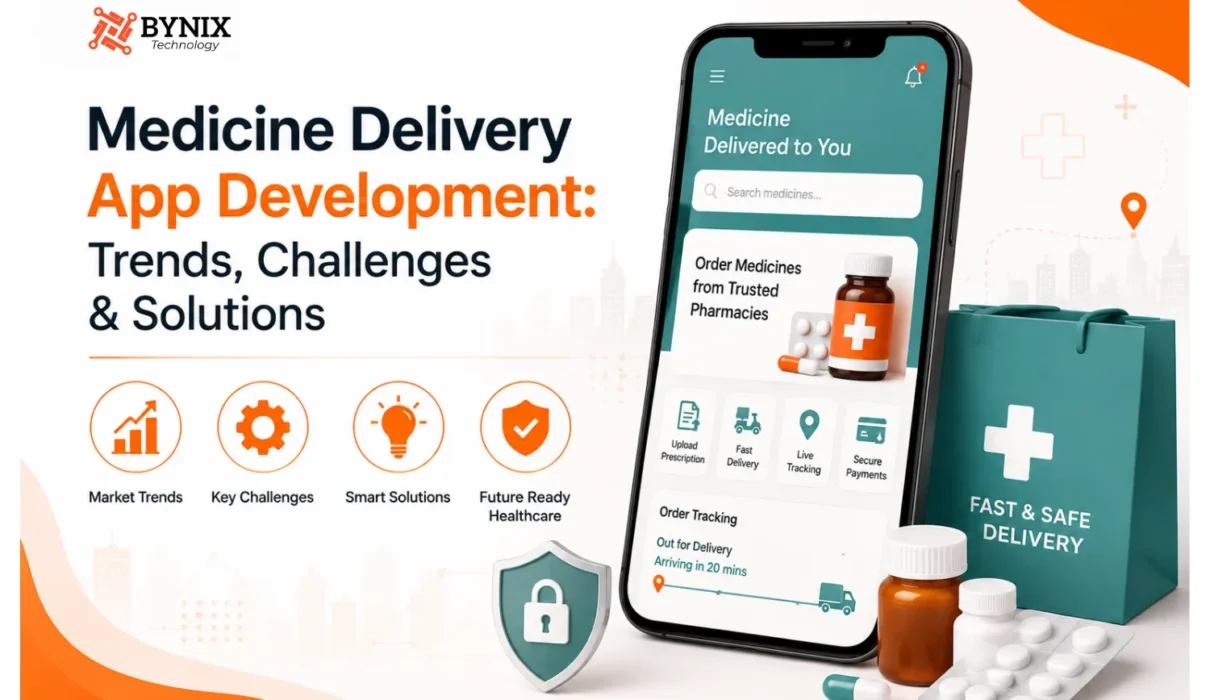
Ordering medicines from a smartphone has become a practical alternative to visiting a pharmacy, especially for repeated prescriptions and elderly patients. But for businesses, building a medicine delivery platform includes far more than creating a digital catalog and adding a delivery option.
The medicine delivery app development challenges can range from prescription verification and inventory accuracy to data security and regulatory requirements. Studies show that up to 80% of digital health startups fail before reaching scale. At the same time, new technologies are changing what customers expect from these platforms, with faster delivery, real-time tracking, personalized experiences, and smarter pharmacy operations.
So, what trends should businesses watch, which challenges deserve the most attention, and how can technology solve them? Let’s review these aspects before you invest in a medicine delivery application.
Understanding the Medicine Delivery App Market
Medicine delivery applications are transforming the healthcare landscape by enabling fast, dependable access to crucial medications without requiring you to visit a physical pharmacy. It has begun as a convenience-driven service, and now it has become a critical component of modern healthcare delivery systems while improving patient experience.
- The medicine delivery app market is estimated to reach USD 50.94 billion by 2030 with a strong CAGR of 28.4%.
- The medicine delivery service market is anticipated to reach USD 132.56 billion by 2030, with a CAGR of 10.75 during the forecast period.
- 2026 market estimation from IMARC suggests that India’s online pharmacy market is projected to reach USD 14.08 billion by 2034.
The numbers might vary as market researchers use different definitions of e-pharmacy, online pharmacy, and health delivery services. However, it is clear that digital medicine purchasing is becoming an impactful and meaningful healthcare channel.
What is driving the demand?
There are multiple factors that contribute to such growth. Some of the prominent ones have been listed here.
- Recurring Prescriptions
Chronic-care patients might need regular refills that create repeat-order opportunities.
- Convenience
Patients can easily search, order, pay for, and track medicines without exploring or visiting multiple pharmacies.
- Better Accessibility
Online platforms can connect customers with pharmacies beyond their immediate neighborhood. So, you can have better access to desirable medications.
- Digital Healthcare Ecosystems
Teleconsultation, diagnostics, e-prescriptions, and medicine delivery can work together in your favor.
- Faster Results
Consumers are becoming accustomed to tracking orders and receiving products within defined delivery windows.
For a business entering this sector, you should know that demand alone doesn’t guarantee profitability or success. The application needs to solve the operational problems behind every successful order. So, you need a professional Mobile app development service to keep the process working in your favor.
Online Pharmacy App Trends Businesses Should Watch
The medicine delivery application industry has been growing with technologies that can encourage patient care while streamlining pharmacy operations. Most importantly, it can also improve customer experience. Here are the top on-demand delivery app trends to watch for.
- Personalized Medicine Recommendations
AI has been adopted widely to assess customer purchase history, prescriptions, medical conditions, and wellness preferences to recommend suitable healthcare products. You can hire AI developers to integrate more personalized suggestions that can improve customer engagement and preventive care.
- AI-powered Prescription Verification
AI-powered prescription verification uses optical character recognition and machine learning. It assesses uploaded prescriptions and validates patient information. It can detect errors while flagging suspicious prescriptions. This is one of the most popular online delivery trends, and it can reduce your manual review time and speed up order processing.
- Integration with Telemedicine Platforms
Telemedicine platforms and digital health records allow doctors to issue electronic prescriptions. Patient records can remain accessible across healthcare providers while enabling faster medicine ordering. You can also be assured of improved treatment continuity and reduced paperwork. This trend can integrate online doctor consultations, electronic prescription transfers, digital health record synchronization, and faster medicine ordering.
- Real-Time Tracking and Smarter Delivery Management
Customers increasingly want to know where their order is and when it is likely to arrive. Real-time GPS tracking, automated delivery updates, and precise estimated delivery times can make the process more transparent. This is where a healthcare logistics app can play an important role. By connecting pharmacies, delivery partners, and customers through an individual system, businesses can handle order allocation and order fulfillment conveniently.
- AI Chatbots for Patient Assistance
AI chatbots offer instant support by answering medicine-related questions, assisting with prescription uploads, checking order status, and guiding users throughout the purchase. Such online pharmacy app trends can improve customer service. It can guarantee 24/7 customer support, instant medicine assistance, automated order tracking, and reduced customer support workload.
- Subscription-Based Medication Refills
Subscription services automatically schedule recurring medicine deliveries for patients with chronic conditions. So, you can hire dedicated app development services to integrate smart reminders and automated payments. You can also implement refill management to help improve medication adherence while reducing missed doses.
List of Medicine Delivery App Development Challenges and Solutions
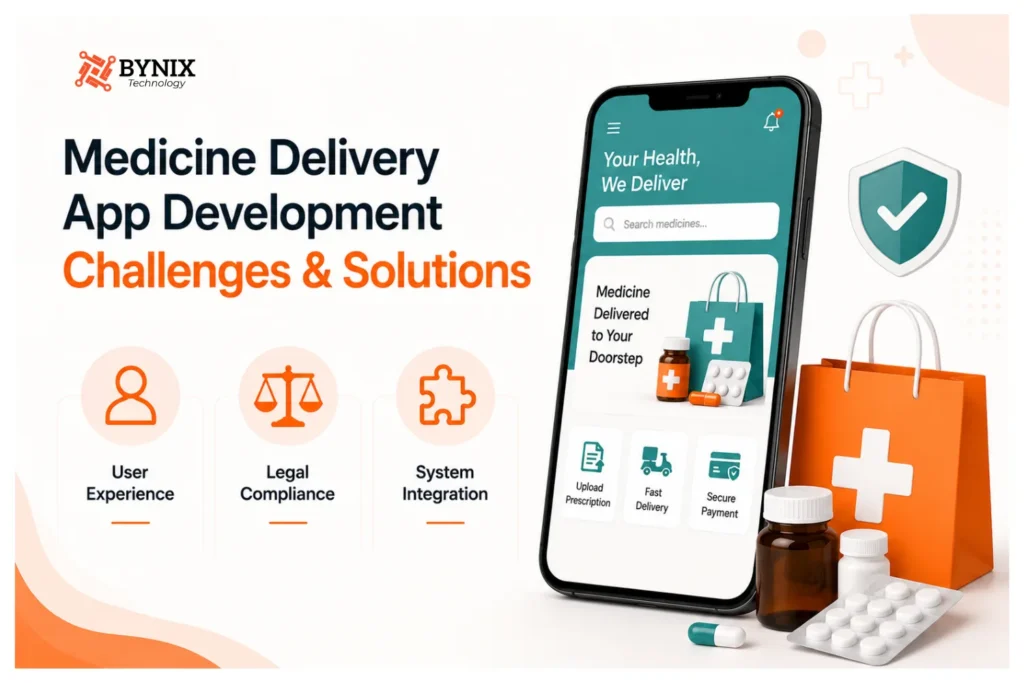
A successful medicine delivery application needs much more than simple coding. It also pushes us to solve multiple issues that come up throughout the whole process. Here are the top medicine delivery app development challenges to look for, along with their practical solutions.
- Design for User Experience
A well-curated medical delivery application should be easy to use and understand. A complicated UI can confuse your users while forcing them to abandon your application midway.
Solution
To determine the places of preference and pain, make sure to do deep user research. You need to follow the best UI/UX practices to encourage user engagement while picking an intuitive and trendy layout.
- Understanding Legal Responsibilities
Exploring the complicated regulatory environment is one of the major obstacles in developing applications for online medicine delivery. Laws vary by sector related to privacy, data protection, and medication distribution.
Solution
To maintain compliance and keep your application within the law, make sure to work with an experienced legal healthcare app development team that is proficient and aware of pharmacy app development requirements.
- Integration with Current Systems
As many pharmacy management systems can’t easily communicate with each other, it can be challenging to integrate your prescription delivery app with them.
Solution
Pick a medicine delivery app development company that focuses on software system integration. To maximize the speed of the process, you can use API and additional integration tools.
- Breach in Data Security
As cyber threats are increasing over time, it is necessary for any online pharmacy application development company to protect users’ health and personal data.
Solution
Keep strong encryption methods in practice and follow data security laws like HIPAA. Update your application frequently to minimize any possible risks in a timely manner.
- Logistics of Delivery
An efficient online medicine delivery app mainly depends on effective logistics. Customer satisfaction might be influenced by delivery defects and delays. This is one of the critical pharmacy app development challenges to consider.
Solution
To guarantee on-time delivery, make sure to collaborate with a trusted neighborhood courier or use a strategy for Uber prescription delivery. For better transparency, you can include real-time tracking capabilities.
- Payment Processing
Customer trust in a pharmacy app development project depends on the integration of reliable and safe payment techniques. If the transaction process is not smooth enough, customers might restrict using your application.
Solution
Select the payment processor that offers multiple types of payment methods and has a high priority on security. Make sure to include cash-on-delivery and wallet options for the convenience of your customers.
- Inventory Management
To succeed in the medicine delivery app market, real-time pharmacy stock level management is very important. This aspect is often overlooked by many businesses.
Solution
Make sure to keep a productive inventory management system that automatically adjusts the stock level and syncs with your application. This will help prevent stockouts and overstock situations.
- Customer Service
It can be challenging to offer strong customer service, especially when handling delicate or sensitive health questions in a medical delivery application.
Solution
To help consumers as soon as possible, set up a multi-channel support system that includes phone, email, and chat. It is necessary to train your customer service agents to answer medical questions effectively and without confusion.
Must-Have Advanced Features in a Medicine Delivery Application
To make an impact in the market, you need to offer competitive functionality and incredible features in your product. Here, you can review some essential on-demand delivery app trends and features to add to your online pharmacy app.
- Drug Search, Filters, and Categories
Your app must make it easy for patients and doctors to find the right drug at the correct dosage. A flexible filtering feature can simplify the process while enabling precise search. With AI suggestions, the feature can be more efficient.
- User Authentication and Profile Management
A basic profile page with a secure login, as well as two-factor authentication, is the basis of most applications. This is very important for one that deals with private medical data. Patients should be able to customize their pharmacy app profile to reflect their medical history and prescriptions.
- Secure Checkout and Multiple Payment Options
Use a reliable payment processor and encrypt all payment data in the app to protect patients and prevent leaks and fraudulent activities. It is also important to offer different payment choices, including pay-on-pickup, credit cards, and installment-based purchases.
- Barcode Scanning for Effortless Refills
This one is effective for pharmacy app development if you want patients to be a bit more autonomous. They will be able to scan the barcode on their medication to bring up the same drug in the app. If they have a prescription for it, make sure to instantly order a refill. No searching or chatting with a pharmacist is needed.
- AI-Based Drug Recommendations
For lighter conditions that don’t need any professional intervention or prescriptions, patients should be able to use your pharmacy app’s built-in recommendations. A trained AI algorithm can advise them on the best medication to treat any specific disease.
- Family Profiles and Multi-User Accounts
Whether it is to help the elderly or kids get their medication, a family version of user profiles can be helpful in your pharmacy application. It is better to set up permissions that allow users to hide certain medications for privacy reasons. This is how families can easily share accounts without any issues.
Conclusion
The opportunity in digital pharmacy is no longer limited to putting a simple medicine catalog on a mobile screen. Stronger products are being built around the complete journey. Some of the effective inclusions are prescription verification, convenient ordering, accurate inventory, secure payments, intelligent fulfillment, and dependable delivery.
The medicine delivery app market is growing, but competition is also raising customer expectations. Businesses entering this space need an application that can handle healthcare-specific complexity while remaining simple for customers to use. If you are also planning to build a pharmacy platform or healthcare delivery solution, explore Bynix Technology’s healthcare-oriented development capabilities. You can easily discuss your product requirements with us while we develop the best outcome that drives results.
FAQs
1. What are the major challenges one might face in developing a medicine delivery app?
The biggest challenges include prescription verification, inventory synchronization, medicine catalog accuracy, data security, regulatory needs, and reliable last-mile delivery. Unlike generic ecommerce, medicine platforms need healthcare-centric workflows.
2. How much does it cost to develop a medicine delivery application?
The cost depends on your app’s features, platform choice, and number of user panels, integrations, and level of customization. A basic pharmacy ordering app will cost less than a multi-pharmacy platform with prescription verification and advanced logistics.
3. How long does it actually take to build a medicine delivery app?
A basic MVP might take a few months, while a feature-rich platform might need considerably more time. The timeline depends on the complexity of the customer application, delivery partner app, and pharmacy dashboard, and compliance requirements.
4. What are some essential features to include in my medicine delivery app?
Some important features that you need to consider for your medicine delivery app include prescription upload, medicine search, order management, secure payments, delivery tracking, customer support, and reorder options.
5. Can a medicine delivery app integrate with existing pharmacy systems?
Yes, a custom app can be integrated with pharmacy management, payment, inventory, mapping, notification, and other third-party systems where suitable APIs or integration methods are available. This can reduce manual data entry and can help keep stock and order information more consistent.