
 By
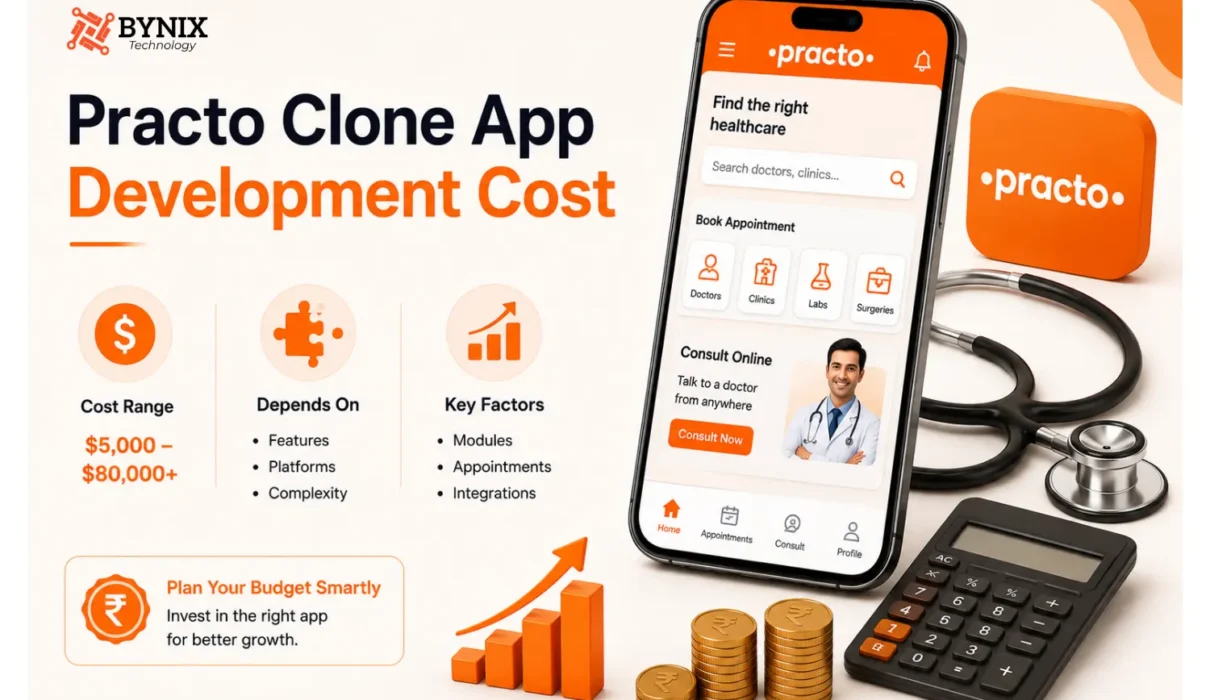
The Practo Clone App Development Cost is usually between $5,000 and $80,000 or more. The final number depends on how the app is built, what features are added, which platforms are used, and how much custom work you need.
If you choose a ready-made clone script, the cost often starts lower. If you go with a Custom Healthcare Practo Clone App Development Cost, the price is higher, but you get more control over what the app can do and how it can grow.
Healthcare app pricing guide tend to rise with doctor and patient modules, appointment booking, online consultations, and payment features. Admin tools also add work. Third-party integrations can push the budget up as well.
This guide breaks down the Practo clone app development cost across every stage, so you can set a realistic budget with more clarity.
What is the Practo Clone App Development Cost?
The total cost depends more on how complex the features are rather than on how many screens you need.
A practical planning budget could be:
| Development Path | Estimated Cost (USD) | Estimated Timeline |
| White-Label Script | $1,000–$3,000 | 3–10 days |
| Basic MVP Build | $10,000–$35,000 | 2–4 months |
| Mid-Level Custom App | $30,000–$60,000 | 4–6 months |
| Enterprise Advanced App | $60,000–$150,000+ | 9+ months |
A basic MVP can start with patient sign-up, doctor listings, search, appointment scheduling, payments, and an admin area.
A larger version can add video check-ins, digital prescriptions, medical history, pharmacy options, booking for tests, and links to third-party healthcare systems.
The cost to build a healthcare app like Practo, you first need a clear scope. Without that, the estimate can go in different directions.
Practo already has a large setup. The firm says it works with over 100,000 doctors. It also lists 9,000+ hospitals and clinics. The service is active in more than 20 countries. These numbers show a mature network. A new startup does not need to match that level at the start.
Which feature affects the total build cost?
A Practo-style system typically has three user groups: Patients, Doctors, and Admins. Each group needs its own workflow.
Patient app
The app for patients usually covers these parts:
- Sign up and sign in
- Patient profile
- Doctor search
- Filters by specialty
- Search by location
- Doctor profile pages
- Availability calendar
- Booking appointments
- Paying online
- Viewing past appointments
- Canceling and rescheduling
- Ratings and written feedback
- Push alerts
- Digital prescriptions
Doctor app or portal
Doctors need a place to handle time slots and talk with patients.
Typical parts you can find in these tools are listed below.
- Doctor registration
- Proof of credentials
- Doctor profile
- Setting up availability
- Appointment calendar
- Patient details
- In-app chat
- Video visits
- Creation of prescriptions
- Booking follow-ups
- Earnings view
- Alerts and reminders
Admin panel
This is the console used by the operations team to run the marketplace.
It includes:
- Confirming doctor information
- Handling patients
- Reviewing upcoming bookings
- Following payment status
- Processing refunds
- Setting commission rules
- Approving review submissions
- Responding to complaints
- Managing site content
- Checking analytics data
- Producing monthly reports
What will it cost to build an app for doctor consultations?
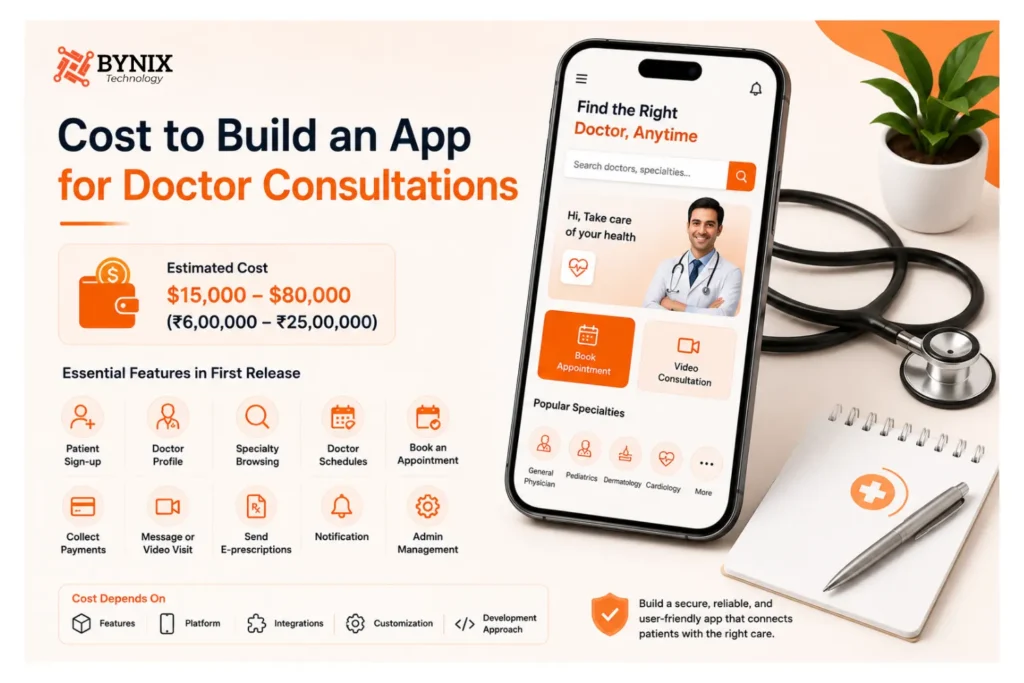
If your primary business model is to connect patients with doctors, you do not have to copy every feature from Practo. The doctor consultation app cost usually varies around $15,000 to $80,000, or about ₹6,00,000 to ₹25,00,000.
Your exact total depends on a few things. For example, the features you pick, whether you use a ready app template or custom development, which platforms you target, what integrations you add, and how much you want the app to be tailored.
In the first release, you can add these parts:
- Patient sign-up
- Doctor profile
- Specialty browsing
- Doctor schedules
- Book an appointment
- Collect payments
- Message or video visit
- Send e-prescriptions
- Notification
- Admin management
Spending can increase a lot once you add medical record work, insurance tasks, subscription costs, remote check-ins, or complex health system links. That is why it often helps to set the first release on one clear work goal. It is usually better than trying to copy every part of a long-running healthcare platform.
What is the telemedicine app development cost?
Telemedicine app development costs depend on the build scope. For a simple MVP, budgets often land around $25,000 to $80,000. If you want a bigger enterprise app, with more functions and added systems, the price can reach $250,000+.
A basic MVP usually includes these parts:
- Patient and doctor logins
- Booking and appointment scheduling
- Doctor availability settings
- Video visits
- Private chat for patients and doctors
- Payment handling
- Digital prescriptions
- Saved consultation records
- Notifications
Advanced features such as EHR integration, remote monitoring, insurance workflows, and analytics may add to costs. Video APIs might make the setup easier. Practo’s online consultation service claims to have 20,000+ verified doctors. It lists 25+ specialties. It also claims that more than 200,000 users have used the service.
Those numbers show how far a well-built consultation platform can go. They also make one point clear. A new startup has to decide which part of the healthcare journey it will handle.
Should You Build a Custom Healthcare App or Use SaaS?
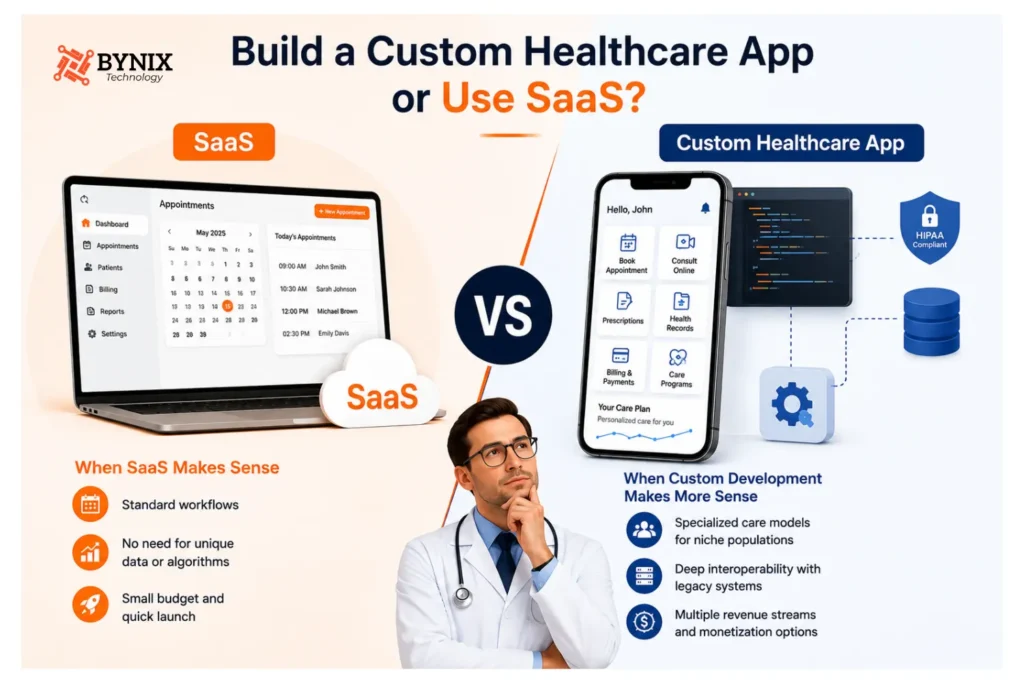
In general, SaaS is ideal for founders who need to launch quickly with standard healthcare workflows, whereas custom development suits businesses who need specialized features, complete control, and long-term scalability. The decision will depend on your budget, technical requirements, compliance needs, and growth plans.
Off-the-shelf Software-as-a-Service (SaaS) solutions allow you to have predictable monthly operational expenditure (OpEx); however, these solutions often restrict how your clinic operates.
When SaaS Makes Sense
- Your clinical operations are based on standard and accepted appointment workflows with no edge cases.
- There’s no need to create your own data asset or your own patient risk-scoring algorithm.
- You’re starting out on a small budget, but need a working booking page to get your business running right away.
When Custom Development Makes More Sense
- Your care model is for a very specific population that generic platforms don’t cater to, for example, occupational health for shift workers.
- You need deep interoperability with a particular hospital’s legacy systems, and you want the data to be translated using custom-made middleware.
- You’re looking to make money across a number of different streams, with tiered subscriptions, premium provider listings, and direct-to-patient transaction fees.
A realistic medical app development cost estimate should also account for long-term scalability. Though at first glance a SaaS subscription seems far less expensive, as you grow your patient base and provider network, the recurring per-user fees and costly feature tier upgrades can significantly impact margins. Understanding this trade-off is key to controlling your overall Practo clone app development cost.
What Factors Increase the Cost of a Doctor Consultation App?
To a patient downloading an app from the App Store, a standalone clinic application and a multi-hospital marketplace could seem the same. But the backend architecture that it takes to run them is very different.
A highly scalable infrastructure is essential for building a platform that can handle a large number of doctors and patients simultaneously. These hidden complexities can significantly affect your final doctor consultation app cost.
Factors That Increase Your Budget:
- Complex user roles: Patients, doctors, administrators, and support staff require different dashboards and access. Building and testing these permissions increases development time.
- Intricate Payment Routing: Multi-party payments are difficult to manage and complicate development. Your system should be able to safely accept a patient’s payment, determine the commission for your platform, and then automatically send the remaining money to the correct practitioner’s bank account.
- Video Infrastructure and Fallbacks: Enterprise-level video streaming with automatic fallback to low video quality in low-bandwidth situations requires special infrastructure.
- Ongoing Maintenance: It is important to consider the costs of routine OS patches, critical security fixes to safeguard patients’ data from emerging risks, and server monitoring.
How Should You Plan Your Healthcare App in Phases?
Waking up with a full-featured platform the day of launch is the quickest way to blow your budget and delay your entry into the market. You can effectively manage the cost to build a healthcare app like Practo by breaking down your product roadmap into strategic, business-oriented development cycles.
Phase 1: Validate the Market Demand
Begin by focusing on the features required to onboard patients and doctors to the platform and let them experience the core booking journey. Add secure registration, doctor search, availability calendars, appointment booking, and consultation features.
Phase 2: Improve Patient Retention
After you verify your core booking engine, invest in features that keep users from leaving. Include secure private messaging for follow-up questions, allow patients to download digital prescriptions, and an automated review system to help establish provider credibility.
Phase 3: Scale the Operations
If your platform is in a position to produce regular income, then you must think about enterprise-level efficiency. Implement automated triage chatbots, connect with wearables for remote monitoring, and develop advanced revenue cycle management tools.
Which Third-Party Integrations Increase Healthcare App Development Costs?
Secure third-party Application Programming Interfaces (APIs) are used to connect your platform to other systems. Integration costs comprise a large part of the healthcare app’s development budget because they form the backbone of modern digital health applications.
You can easily integrate proven and compliant technology into your platform instead of creating your own complex systems.
Some important integrations to keep in mind:
- Payment Gateways: Solutions such as Stripe ensure safe credit card processing and handling of digital wallets, along with complex provider payouts, all the while complying with PCI standards.
- Video Streaming: Take advantage of trusted vendors such as Twilio or Vonage to stream video consultations. Trying to create and maintain a HIPAA-compliant video server on your own has huge security and reliability risks.
- Electronic Health Records (EHR): Integrating your app with the hospital’s electronic health records ensures that doctors can easily access patient medical history.
- Calendar Systems: Integration with Google Calendar and Microsoft Outlook eliminates the possibility of a double booking, which is critical for physician retention.
- Pharmacy Networks: Doctors can integrate with digital pharmacy networks to directly send prescriptions to the patient’s local chemist.
How Can You Control Your Healthcare App Development Budget?
There’s no need to have an infinite amount of funding to build a successful platform. However, with proper planning, it is possible to maintain a telemedicine app development cost while still providing a high-quality experience to patients.
Grand View Research estimates the global telehealth market will reach $432.31 billion by 2030. To win a share of this growing market, there has to be strategically focused execution and not just massive spend.
Practical Steps to Keep Healthcare App Development Costs Down
- Choose One Market First: Start by targeting a specific region or a single medical specialty. Going international right away means navigating different compliance regulations, dealing with multiple currencies, and paying out too heavily on initial marketing efforts.
- Limit Your First Release: Skip unnecessary AI features or complex health tracking dashboards in Version 1. Only focus on filling the gap between doctor and patient communication.
- Decide Your Platform Strategy Early: You can save up to 40% of your development time by building a responsive web app or a single native app (such as iOS) first. The second platform can be funded after receiving user feedback.
- Define Target Users Precisely: Any miscommunication with your development team equals billable hours. Put more time into the planning process and establish precise user flows and wireframes before coding.
- Plan for Post-Launch Maintenance: Allocate 15% – 20% of the total budget for post-launch bug fixes, OS updates, and server performance monitoring.
The main benefit of hiring a development agency is that it provides an accurate feature-level estimate, while keeping you clear about your development budget.
White-Label or Custom: Which Should You Choose?
Once you know what you’re paying for, you’ll be able to justify the initial Practo clone app cost associated with a tailored platform.
- When it comes to speed and basic functionality, white label is the way to go.
- If you’re looking to test and validate a concept in a couple of weeks, and you don’t have a lot of money to spend, ready-made scripts get you to market quickly.
- A white-label product may become costly down the road, though; it will be heavily customized later to align with complicated compliance needs or unique clinical processes.
- A custom build will cost more upfront, but will give you an architecture that you can scale to match your operations.
- Also, with custom development, you have the ability to own the source code of your software, based on your specific contract agreements. This makes it a valuable asset for your business.
Conclusion
The right development budget starts by identifying the exact product your business needs, rather than the maximum number of features you can afford to build. With a booking and consultation MVP, you can test patient demand and gain market traction before spending significant capital on advanced integrations, automation, and complex medical analytics.
Looking to build a Practo-like healthcare app? Contact Bynix today to talk to our engineering team about your key features, deployment timeline, and technical development budget in your healthcare app development project.
Frequently Asked Questions
How much should I budget for healthcare app maintenance after launch?
Allocate about 15% – 20% of your initial development costs for annual maintenance. This includes critical Operating System updates to maintain compatibility, third-party API modifications, critical security fixes to keep your platform secure as you get more users, and normal bug fixes to keep your platform stable.
Is a white-label healthcare app cheaper than a custom app?
Since the base code is present, a white-label app will involve a much smaller initial investment. If your business does need customizations and special administrative processes later, though, adding these features to a rigid white label script may be more expensive than developing a customized app in the first place.
Can I launch a healthcare app with only one platform?
Yes. Many successful digital health startups build an iOS mobile app or a responsive web application first, to test their market. A single platform means you can get your development time underway and collect real user feedback before investing in a second platform.
Which integrations usually increase healthcare app development costs?
The integration of Electronic Health Record (EHR) and Electronic Medical Record (EMR) usually adds the most expense during development. To integrate your application with these legacy hospital databases, you have to perform complex data mapping processes, implement security measures, and use many hours of engineering work to ensure that sensitive health information is synced without any errors.
What should I include in the first version of a Practo-style app?
Your first release should focus strictly on core transactional features. Include patient and doctor registration, a searchable provider directory, an availability calendar, secure appointment booking, a reliable payment gateway, and a basic video consultation portal to facilitate patient care effectively.